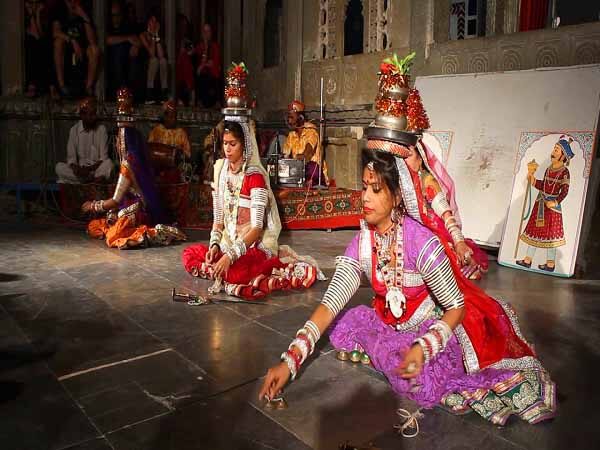
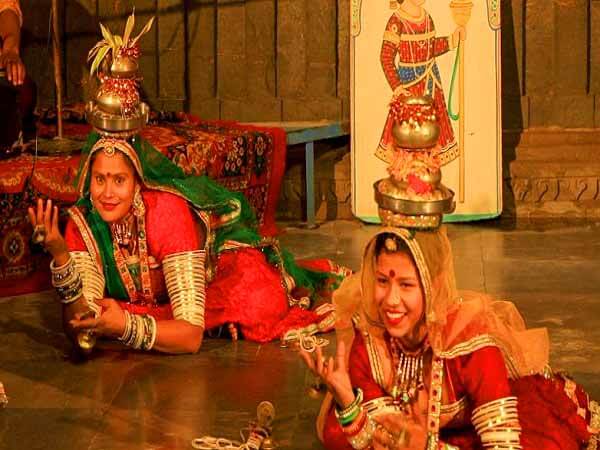
The Terah Tali Dance of Rajasthan is a unique and mesmerizing devotional folk dance that stands out for its distinctive use of thirteen metal cymbals (manjeeras) tied to various parts of the performer's body. This sacred Tera Tali dance, meaning "thirteen cymbals" in Hindi, is performed predominantly by women of the Kamad community in Rajasthan, who are traditional snake charmers and have practiced this art form for centuries. The dance is dedicated to Baba Ramdev Ji, a revered folk deity of Rajasthan who is worshipped across the state for his commitment to social equality and spiritual teachings. What makes this 13 cymbals dance truly extraordinary is that performers remain seated on the ground throughout the entire performance, striking the cymbals rhythmically while maintaining perfect coordination and creating enchanting musical patterns. Discover more devotional folk dances of Rajasthan that showcase the state's spiritual and cultural richness. The Terah Tali dance Rajasthan combines elements of devotion, musical precision, and physical coordination, creating a meditative performance that transports audiences into a spiritual realm while demonstrating the incredible skill and dedication of professional Rajasthani Terah Tali artists who preserve this ancient tradition.
Thirteen metal cymbals tied to different body parts - wrists, elbows, waist, and legs - creating divine rhythmic patterns in devotion to Baba Ramdev Ji
History and Origins of Terah Tali Dance
The Terah Tali Dance of Rajasthan has deep spiritual and historical roots in the devotional traditions of the Kamad community, who are followers of Baba Ramdev Ji (also known as Ramsa Peer or Ramdev Pir). Baba Ramdev was a 14th-century saint and social reformer who worked tirelessly for the upliftment of lower castes and advocated social equality. The Kamad community, traditionally involved in snake charming and folk performances, adopted this dance form as their special offering of devotion to their beloved deity.
The dance is believed to have originated in the Pali and Barmer districts of Rajasthan, where the Kamad community has historically been concentrated. The tradition of using thirteen cymbals is symbolic - the number thirteen represents the twelve months of the year plus the divine presence that guides all time. Each cymbal is carefully placed on specific body parts, and the performer strikes them in precise sequences that create rhythmic patterns believed to invoke divine blessings and create spiritual harmony.
The performance of Terah Tali dance is intrinsically linked to religious festivals, particularly during the Baba Ramdev Fair (Ramdevra Mela) held annually in August-September at Ramdevra temple in Jaisalmer district. During this massive pilgrimage that attracts hundreds of thousands of devotees, Terah Tali performers showcase their art as an act of devotion and spiritual connection. The dance is performed throughout the night during these festivals, with performers entering trance-like states as they lose themselves in the devotional music and rhythmic cymbal patterns.
Historically, the Tera Tali dance Rajasthan was performed exclusively within the Kamad community and passed down through generations from mothers to daughters. Young girls would begin learning the intricate cymbal placements and rhythmic patterns from childhood, developing the coordination and musical sense required for this demanding performance. The dance served not just as entertainment but as a form of worship, meditation, and community identity. Over time, the dance gained recognition beyond the Kamad community, with cultural organizations and government bodies supporting its preservation as an important part of Rajasthan's intangible cultural heritage. Today, while still deeply rooted in devotional practice, Terah Tali is also performed at cultural festivals, heritage events, and tourism programs, helping to sustain the tradition and provide livelihood opportunities for the artists who dedicate themselves to preserving this unique art form.
Terah Tali Performance Style & Technique
The performance of Terah Tali Dance is a remarkable display of rhythmic coordination, musical precision, and devotional intensity. Unlike most folk dances that involve standing and moving across space, Terah Tali is performed entirely in a seated position, which adds a unique dimension to its challenge and aesthetic appeal.
Cymbal Placement
Thirteen small metal cymbals (manjeeras) are meticulously tied to different parts of the performer's body using cloth strings. Two cymbals are tied to each wrist, two on each elbow, one at the waist, and three on each leg. The remaining cymbal is held in the hand and used as the striker to create sounds on the other twelve cymbals.
Rhythmic Coordination
The performer strikes the cymbals in specific sequences and patterns that match the devotional songs being sung. The coordination required is extraordinary - while maintaining a seated position, the performer must reach different body parts in rapid succession, creating complex rhythmic patterns that complement the musical accompaniment.
Devotional Expression
While executing the technical elements, performers maintain deep devotional concentration, often entering meditative or trance-like states. Facial expressions reflect spiritual devotion, and the entire performance is conceived as an offering to Baba Ramdev Ji rather than mere entertainment, giving it profound spiritual significance.
Seated Posture
Performers sit in a specific cross-legged position (padmasana or variations) throughout the performance, which can last 30-45 minutes or longer during religious festivals. Maintaining this posture while executing complex arm and torso movements requires exceptional flexibility, strength, and stamina developed through years of practice.
Performance Structure
A typical Terah Tali Dance of Rajasthan performance begins with the performer entering the performance space and taking her seated position. The manjeeras are already tied to her body, carefully positioned to ensure both accessibility and comfort. Musicians begin playing traditional folk instruments - primarily the dholak (hand drum) and tanpura or sarangi (string instruments) - while singers begin devotional songs dedicated to Baba Ramdev Ji. The performer starts with slow, deliberate strikes on the cymbals, establishing the basic rhythm. As the music intensifies, the striking becomes faster and more complex, with the performer creating intricate patterns by hitting different cymbals in rapid succession. The metallic sounds of the thirteen cymbals, when struck in perfect coordination, create a mesmerizing auditory experience that complements the devotional singing. During particularly intense moments, the performer may sway her torso, adding a visual element to the performance while never rising from her seated position. The performance reaches its climax with the fastest and most complex rhythmic sequences, often lasting several minutes, before gradually slowing down to a peaceful conclusion. Throughout the entire performance, the devotional intent remains paramount, with the technical virtuosity serving the spiritual purpose of offering worship through art.
Musical Accompaniment & Devotional Songs
Traditional Instruments
The Tera Tali dance Rajasthan is accompanied by a small ensemble of traditional folk musicians who play specific instruments that complement the cymbal sounds. The primary percussion instrument is the dholak, a two-headed hand drum that provides the rhythmic foundation for the entire performance. The dholak player must have exceptional skill to maintain various rhythmic cycles (taals) throughout the performance, coordinating with the cymbal strikes.
Melodic support comes from string instruments like the tanpura, which provides a droning background sound that creates the devotional atmosphere, or the sarangi, a bowed string instrument that plays the melodic lines. In some performances, the been (pungi) or algoza (double flute) may be used, especially since the Kamad community has historical connections to snake charming traditions where these instruments were commonly used.
Devotional Songs (Bhajans)
The songs sung during Terah Tali Dance performances are devotional hymns (bhajans) dedicated to Baba Ramdev Ji and other folk deities of Rajasthan. These songs are sung in the local Rajasthani dialect and tell stories of Baba Ramdev's life, his miracles, his teachings of equality and compassion, and his divine powers. The lyrics often emphasize themes of devotion, surrender to the divine, and the transcendence of worldly attachments.
The singers are usually women from the performing community who have inherited these songs through oral tradition. Their voices carry the emotional and spiritual weight of centuries of devotional practice. The singing style is distinctive, characterized by strong, powerful voices that can sustain long notes and create the haunting, meditative quality essential to the performance. The interaction between the vocal lines, instrumental accompaniment, and cymbal rhythms creates a rich, layered soundscape that is both musically complex and spiritually moving, drawing both performers and audiences into a shared devotional experience.
Cultural & Religious Significance
The Terah Tali Dance of Rajasthan holds profound cultural and religious significance that extends far beyond its artistic and entertainment value. This dance is fundamentally an act of worship, a form of devotional service (seva) offered to Baba Ramdev Ji, making it inseparable from the spiritual beliefs and practices of the Kamad community and Baba Ramdev's devotees.
Spiritual Devotion & Trance States
For performers, the Terah Tali dance is a pathway to spiritual connection and divine experience. During extended performances, especially at religious festivals, performers often enter trance-like states (known as "bhav" or divine possession) where they lose awareness of their surroundings and physical sensations. In this state, they believe they are completely surrendered to Baba Ramdev Ji, and their performance becomes a channel for divine energy. Witnesses describe seeing performers in such deep trance that they continue dancing for hours without showing signs of fatigue, their faces radiant with spiritual ecstasy. This phenomenon is considered proof of Baba Ramdev's presence and blessings, reinforcing faith among devotees who witness these performances.
Social Equality & Community Identity
Baba Ramdev Ji was a revolutionary social reformer who championed the cause of lower castes and marginalized communities, particularly the Meghwal community to which he belonged. The Rajasthani Terah Tali dance, performed primarily by the Kamad community (also traditionally considered lower caste), embodies these values of social equality. The dance serves as a powerful assertion of cultural identity and dignity for communities that have historically faced discrimination. Through their art, performers reclaim their heritage and demonstrate that spiritual devotion and artistic excellence know no boundaries of caste or social status.
Oral Tradition & Cultural Preservation
The transmission of Terah Tali from generation to generation through oral and physical instruction represents an important mechanism for cultural preservation. Unlike written traditions, this embodied knowledge is passed directly from experienced performers to young learners within families and communities. This method of transmission carries not just the technical skills but also the devotional attitudes, community values, and spiritual meanings associated with the dance. In an era of rapid modernization, the continuation of Terah Tali represents a living link to centuries of cultural and spiritual practice.
Contemporary Relevance
Today, while the Terah Tali Dance of Rajasthan remains primarily a devotional practice performed at religious festivals, it has also gained recognition as an important cultural heritage art form. Government cultural programs, heritage hotels, and tourism initiatives have created new opportunities for Terah Tali performers, providing them with income and exposure while helping to preserve the tradition. However, performers and cultural experts emphasize the importance of maintaining the devotional essence even when performing in secular contexts. The challenge and opportunity lie in sharing this beautiful tradition with broader audiences while preserving its spiritual heart and ensuring that it remains a living, practiced art form within its originating communities rather than becoming merely a museum piece or tourist spectacle.
Traditional Costume & Preparation
Performance Attire
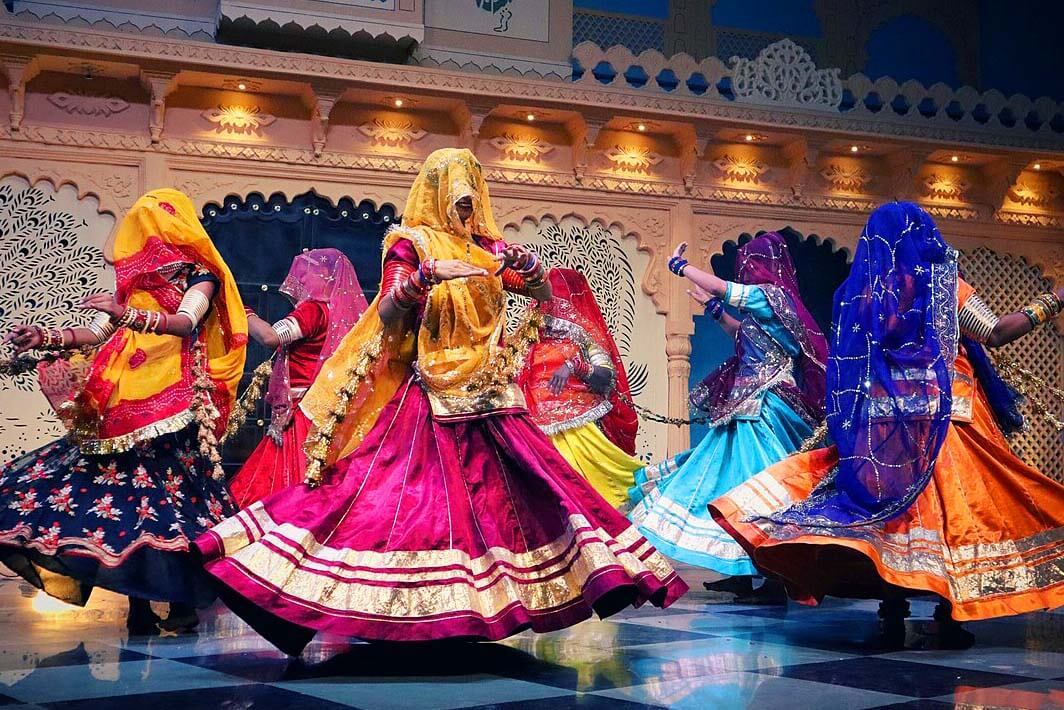
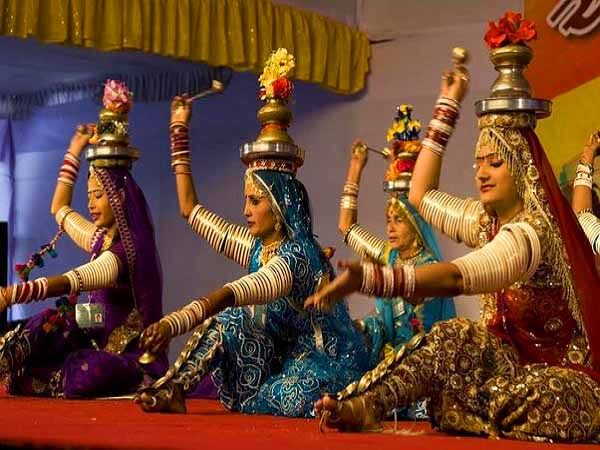
The costume for Terah Tali Dance performers reflects traditional Rajasthani folk attire with specific adaptations for the unique requirements of this seated, cymbal-based performance. Female performers wear colorful ghagras (long skirts) in vibrant hues like red, orange, green, and yellow, often featuring traditional mirror work, embroidery, or bandhani (tie-dye) patterns that are characteristic of Rajasthani textile arts.
The choli (blouse) is typically short-sleeved or sleeveless to allow freedom of arm movement essential for reaching and striking cymbals tied to different body parts. An odhni (veil) is draped over the head and shoulders, adding to the traditional appearance and also serving a devotional purpose by covering the head in the presence of the divine. The colors and patterns chosen often have symbolic significance, with red being particularly favored as it represents devotion and auspiciousness in Hindu religious contexts.
Jewelry & Adornments
Traditional Rajasthani jewelry is an important part of the Terah Tali costume, though it must be chosen carefully to avoid interfering with cymbal placement and arm movements. Performers typically wear silver jewelry including necklaces, bangles on the forearms (not the wrists where cymbals are tied), anklets, nose rings, and earrings. The jewelry serves both aesthetic and symbolic purposes - its metallic sounds add to the overall auditory experience, while its presence connects the performer to traditional cultural aesthetics and devotional practices.
Cymbal Preparation
The thirteen manjeeras (cymbals) are small, typically 2-3 inches in diameter, made of brass or bronze alloy. Before each performance, these cymbals must be carefully tied to the performer's body using strips of cloth or special elastic bands. The tying process is crucial - the cymbals must be secure enough not to slip during performance but not so tight as to restrict blood flow or cause discomfort during what can be lengthy performances. Experienced performers develop their own techniques for achieving the perfect balance. The placement of each cymbal is traditional and purposeful - specific body locations produce optimal sound when struck and allow for the most efficient striking patterns. The preparation process itself becomes a meditative ritual, helping the performer focus her mind and enter the devotional state necessary for authentic performance.