Daph Dance in short
- What it is: a seasonal folk dance of Haryana, associated with farming communities and the spring harvest.
- Its name: it takes its name from the daph, the one-sided drum that drives the performance.
- Who takes part: men and women from the village community dance, in separate groups.
- Its music: the daph, alongside traditional melodic instruments, with the sound of the women's ornaments adding to the rhythm.
The basics
What is Daph Dance?
Daph Dance is one of the traditional folk dances of Haryana. The Haryana Department of Art and Cultural Affairs lists it among the state's major folk dances and describes it as “mainly a seasonal dance performed by farmers to commemorate a bountiful harvest on the advent of spring season”.
It belongs to the cycle of Haryanvi village dances that follow the agricultural year rather than a temple or classical repertoire. Daph is offered in the open, by and for the village community, when the harvest is in and the working year briefly pauses — which is why it is usually described as a harvest or spring festival dance rather than a stage form.
The dance is inseparable from its instrument. Published descriptions of Haryanvi folk music note that the daph used in this dance is an ancient instrument, and that the sound of the ornaments worn by the women also becomes part of the dance orchestra. Where there is no daph, there is no Daph.
| State / region | Haryana, India — a rural, village-based tradition |
|---|---|
| Season | Spring, at the time of the harvest (Phalgun / February–March in the traditional calendar) |
| Named after | The daph, a one-sided drum (also referred to as daphli in study material on Haryana's dances) |
| Performers | Men and women of the village community, dancing separately |
| Accompaniment | Daph drums; traditionally flute, been and lute for melody; the dancers' ornaments contribute to the rhythm |
| Occasion | Harvest and spring celebrations, village fairs and community gatherings |
History
Daph Dance: origin and history — what the record actually shows
Daph Dance has no reliably documented founder or founding date. Like most Haryanvi folk dances, it belongs to an oral village tradition passed on through practice and song rather than through written records, so its history is best described through its setting — the agricultural calendar and the spring harvest — rather than through a date.
What the available documentation does establish is this:
- The Haryana Department of Art and Cultural Affairs records Daph as a state folk dance tied to the harvest and the arrival of spring.
- Descriptions of Haryanvi folk music record the daph as an ancient instrument, used for this dance and accompanied by flute, lute and been.
- The dance is documented as a community performance in which men and women of “all sections of the village community participate … separately”.
Culture
Cultural significance of Daph Dance
In Haryana, folk dance is a shared activity rather than a performance watched from a distance. The state's Department of Art and Cultural Affairs notes that these dances create a sense of unity and togetherness — at festivals, fairs and ceremonies such as marriage, birth and the harvest, people come together to dance and rejoice.
Daph fits that pattern closely. It is a thanksgiving for a good crop, a way of marking the end of a demanding season, and an occasion where the whole village takes part. Two features stand out in the documented description:
Participation, not spectatorship
Daph is described as involving men and women of all sections of the village community, dancing separately rather than in mixed pairs. The dance therefore reflects the social organisation of village life while giving every group its own moment.
Sound that belongs to everybody
Along with the daph drums and the older melodic instruments, the sound of the ornaments and bangles worn by the women is treated as part of the dance orchestra. Everyday dress and jewellery are part of the music, which is one reason the performance feels communal rather than staged.
Music
Music and the role of the daph instrument
The daph gives the dance both its name and its pulse. It is a one-sided drum held and struck by hand, giving a sharp, carrying beat that is easy to follow in an open field or a village courtyard — the settings where Daph is traditionally performed. Study material on Haryana's folk arts usually refers to this circular wooden drum as the daphli.
Around the drum, older descriptions of Haryanvi folk music place flutes, lutes and the been as melodic instruments used by the “ancient Haryanavis”, with the songs suited to the occasion. In Daph specifically, the documentation is consistent on one point: the percussion and the dancers' ornaments carry the rhythm, and the singing follows the harvest occasion.
For event audiences, the practical consequence is that Daph is a live, acoustic-led dance. It relies on drumming and singing rather than recorded playback, which is why an authentic presentation of it usually involves a small accompanying group of musicians rather than a single track.
Performance
Movement and performance characteristics
Published descriptions of Daph Dance are short, and none of them set out a step-by-step choreography. What is documented is its character: a seasonal dance “performed by farmers to commemorate a bountiful harvest”, expressing the joy of a good crop, with the drum and the dancers' ornaments providing the rhythm.
From that, the following characteristics are safe to state:
- Group led, rhythm first. The beat of the daph organises the movement; the dance rises and falls with the drumming.
- Separate men's and women's groups. The village community participates in separate groups rather than as couples.
- Open-air, circular, communal. It is a village-ground and courtyard performance rather than a proscenium composition.
- Occasion-bound. It is tied to the spring harvest and celebratory gatherings, not to the temple or to a ritual calendar.
Presentation
Dress and stage presentation
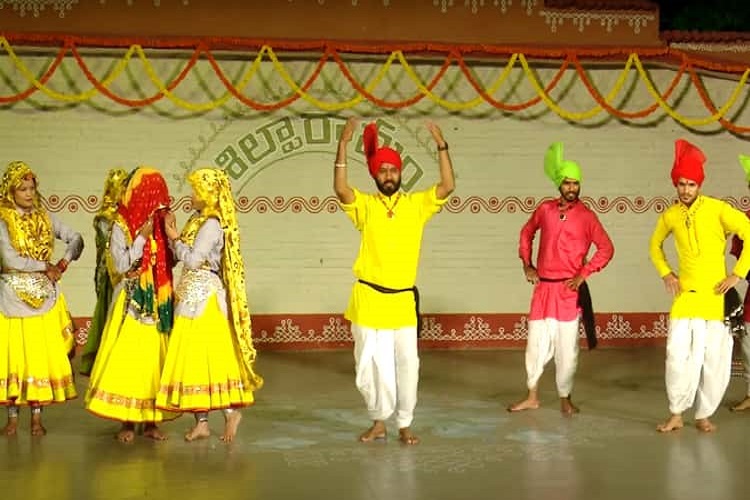
The sources consulted for this page do not describe a separate costume code for Daph Dance. Documentation of neighbouring Haryanvi traditions gives us the general vocabulary of dress in the region — for example, Loor dancers are recorded in ghagra, kurti, chundri and chunda, while Khoria dancers are described in gold-work skirts with brightly coloured dupattas and heavy rustic jewellery — but those descriptions belong to those dances and should not simply be pasted onto Daph.
In practice, a Daph presentation for an audience keeps to the village-festive dress of Haryana: traditional clothing and jewellery for the dancers, with the ornaments doing double duty as sound. The precise dress is best agreed with the performing team in advance so that it matches the occasion.
Clarity
Daph Dance is not the same as Daff, Phag or Dhamal
The names are close, so it is worth being precise. Daph is a Haryanvi spring-harvest folk dance. The others below are separate traditions, each with its own documentation:
- Daff folk dance of Punjab shares the frame-drum name but belongs to Punjab, not Haryana — a different tradition and a different repertoire.
- Phag dance is performed by farmers in the month of Phalgun and is a mixed dance, with men wearing colourful turbans during the performance.
- Dhamal dance is performed only by men in the Gurgaon region, and is documented as being performed when the crop is ready for harvest.
- Loor dance is performed by girls around Holi in the spring, in the Bangar and Bagar belt.
- Jhumar dance is a young women's dance performed to the dholak and thali, and is not a harvest dance of the same kind as Daph.
If your programme calls for one of these rather than Daph, say so in your enquiry — the performing teams are briefed differently for each.
Occasions
When and where Daph Dance is performed?
Traditionally, Daph Dance belongs to the spring harvest — the point in the year when the crop is in, the season turns, and the community celebrates together. That is the occasion it was made for, and it is the context in which it is documented.
Beyond the fields and the village ground, Daph is a natural fit for a stage where a folk-theme performance is wanted:
Harvest & spring festivals
Programmes built around the harvest, the arrival of spring or community thanksgiving.
Cultural & heritage shows
State-culture evenings, society and college cultural events, and heritage programmes where Haryanvi folk forms are showcased.
Celebratory functions
Weddings and family functions where a folk performance number is part of the planned programme.
What matters most for a good Daph performance is context: it works best as part of a programme that makes room for a folk number with live percussion, rather than as background entertainment. If your audience is unfamiliar with Haryana's traditions, a short spoken introduction before the piece helps considerably.
Booking
Arranging a Daph Dance performance for your event
A Daph Dance performance is arranged around your programme, not sold as a fixed package. The performing team is put together for the date and the venue, and the line-up — dancers plus the musicians who carry the daph and the rhythm — is confirmed once the event details are known.
Send the following and you will get a specific reply rather than a generic one:
- Event date — and the time slot if the programme is already fixed.
- City and venue — indoor or outdoor, and whether a raised stage is available.
- Occasion or event type — harvest festival, cultural programme, college event, wedding or society function.
- Programme requirements — how long the folk number needs to run, and whether it should sit inside a longer sequence.
- Audience — approximate size and whether a short spoken introduction would help them follow the performance.
- Your preferences — any particular Haryana folk style or combination of styles you want included.
On the enquiry form, choose Artist Type → Dancer and mention “Daph Dance, Haryana” in the details so the request reaches the folk-performance team straight away.
From the archive
Daph Dance and Haryanvi folk performances
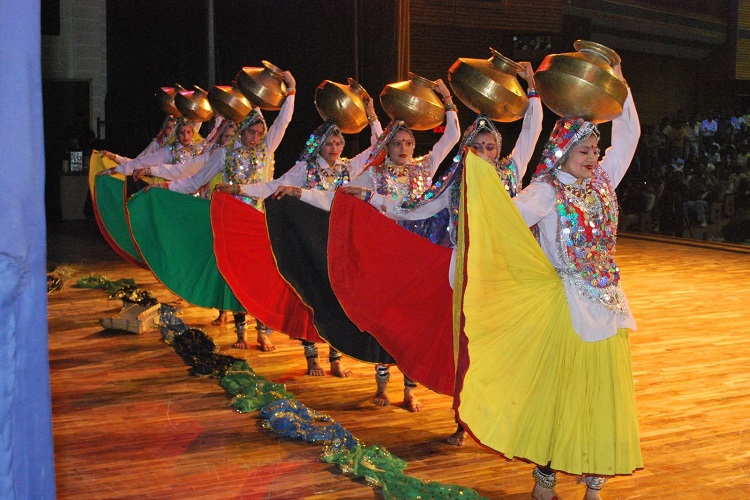
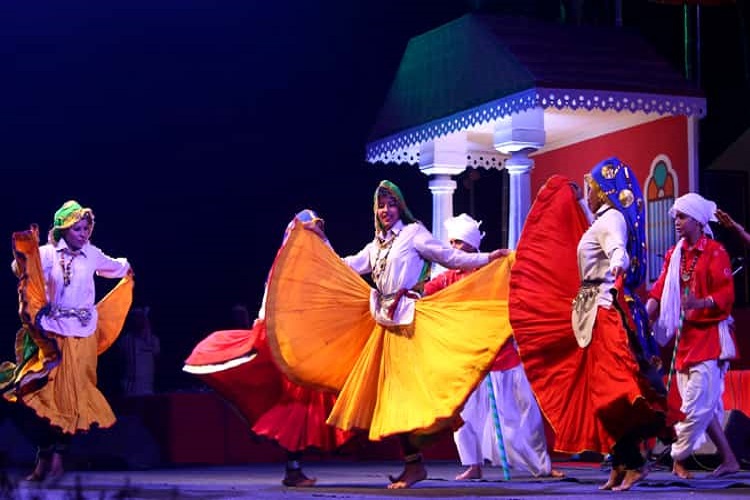
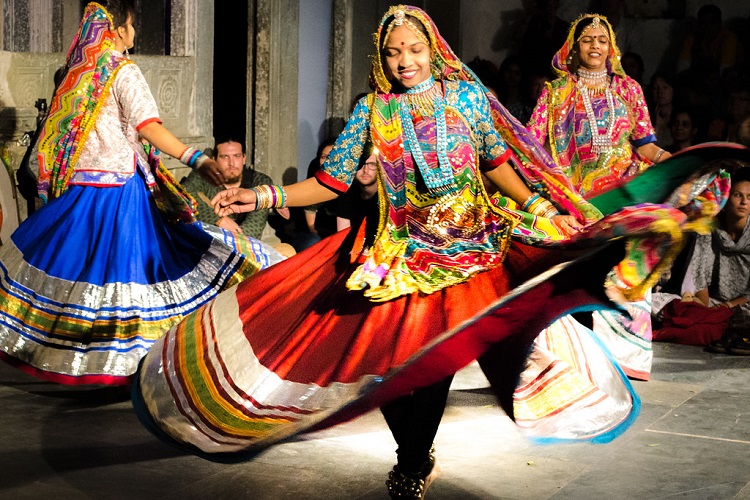
Photographs from the company's performance archive showing Haryanvi folk ensembles with daph drums, dhol and traditional dress.
FAQs
Daph Dance — frequently asked questions
What is Daph Dance of Haryana?
Daph Dance is a traditional folk dance of Haryana performed by farming communities around the spring harvest. The state's Department of Art and Cultural Affairs describes it as a seasonal dance performed by farmers to commemorate a bountiful harvest at the advent of spring.
Why is it called Daph Dance?
It takes its name from the daph — a one-sided drum that provides the beat for the performance. Study material on Haryana's folk arts also refers to this circular wooden drum as the daphli.
When is Daph Dance performed?
Traditionally at the spring harvest, in the month of Phalgun — roughly February to March — as a thanksgiving for the crop. It is a community celebration rather than a fixed ritual date, so performances are tied to the harvest season and to village gatherings.
Who performs Daph Dance — men, women or both?
Both. Documented descriptions record that men and women of all sections of the village community participate in Daph, dancing in separate groups rather than as mixed couples.
Is Daph the same as Daff or Phag?
Can a Daph Dance performance be arranged outside Haryana?
Yes — enquiries are taken for events in Delhi NCR and other cities. Availability depends on the performing team and the date, so share your event city and date and the team will confirm what can be arranged for your programme.
What should I include in a Daph Dance booking enquiry?
Event date and time slot, city and venue (indoor or outdoor, and whether there is a raised stage), the occasion, how long the folk number should run, your approximate audience size, and any preference among Haryana's folk styles. Send these through the enquiry form or on WhatsApp and you will get a specific answer.
Do you arrange other Haryana folk dances too?
Yes. Alongside Daph, the performing network covers other Haryanvi forms such as Phag, Dhamal, Loor and Jhumar. See the Haryana folk dance page for the wider list.
Explore
Related folk dance pages
- Folk dances and dancers of HaryanaEvery documented Haryana folk form in one place, with the wider Haryanvi repertoire.
- Folk dances of India — full directoryState-by-state index of Indian folk dances, for programmes that mix regions.
- Phag danceThe mixed Phalgun dance of Haryana's farming communities.
- Dhamal danceThe men's harvest dance of the Gurgaon region.
- Loor danceA girls' spring dance of the Bangar and Bagar belt.
- Jhumar danceHaryana's young women's dance, performed to dholak and thali.
- Folk songs (lokgeet) of IndiaFolk vocal traditions that accompany dances such as Daph.
- Dance performances for college festsProgramme planning for student cultural events.
Enquire about a Daph Dance performance
Tell us the date, city, venue and occasion, and we will come back with what can be arranged for your programme — Daph Dance or a wider Haryanvi folk sequence.