Dappu Dance — the Telugu Folk Drum Dance
A group of dancers, each carrying a large round frame drum, moving as one rhythm. Here is what Dappu Dance is, where it comes from, and how to arrange a Dappu performance for your event.
- 10+ years arranging performers in Delhi NCR
- Weddings, corporate & cultural programmes
- In-station and outstation groups
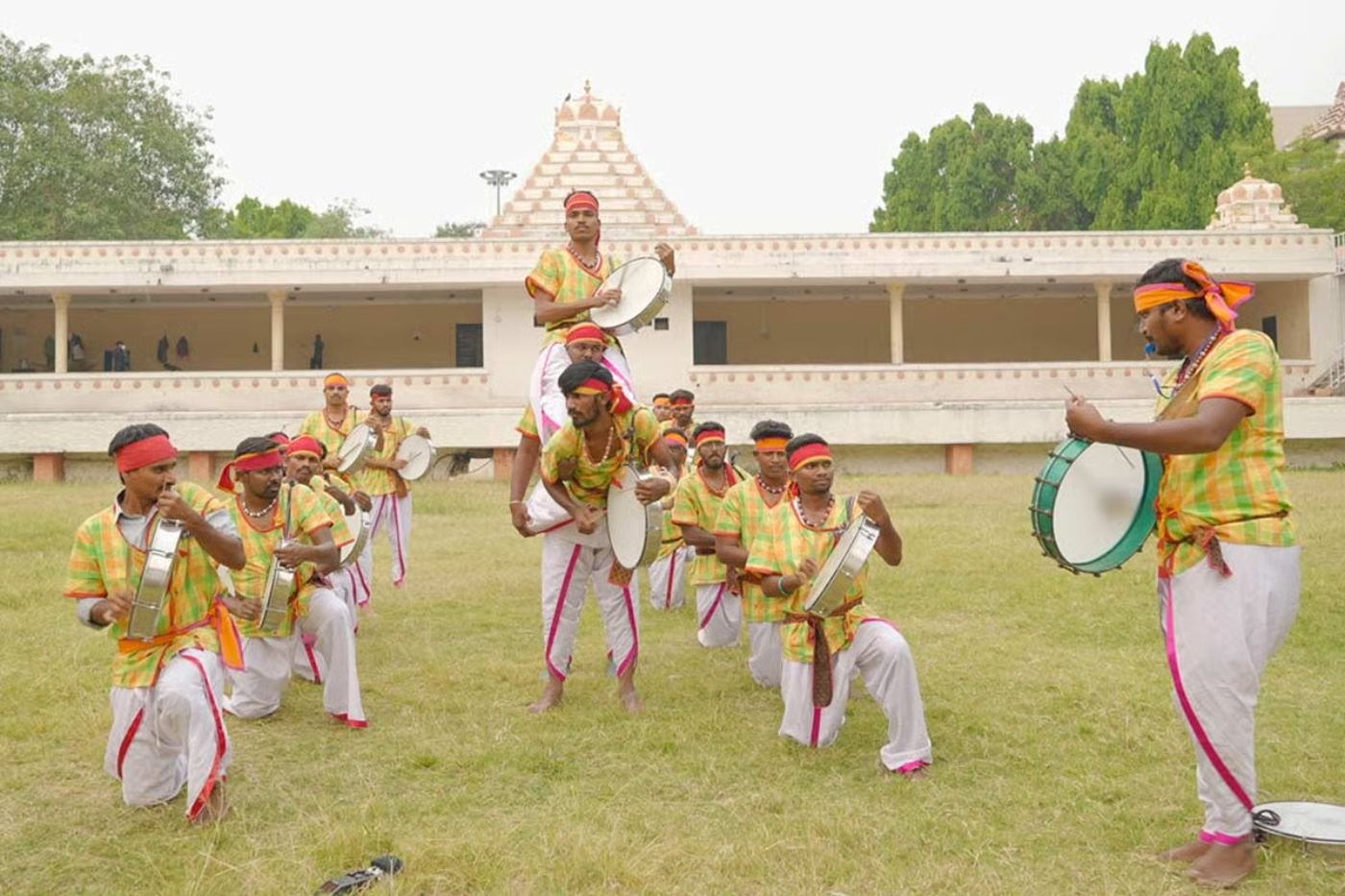
Photo: Dappu training session in Hyderabad — The News Minute. Illustrative of the tradition; not a photograph of our own artists.
What is Dappu Dance?
Dappu Dance is a Telugu folk performance in which a group of dancers move together while each of them plays the dappu — a large, round, single-sided frame drum held in the hand or slung across the shoulder. The dance is named after the instrument.
There is no separate band leading it. The dancers are the percussion section, and the drum sets the tempo, the footwork and the shape of the whole group. This is why Dappu is often described simply as a drum dance: the beat is not background music. When the group strikes harder and faster, the dancers widen their steps, change formation and build to a climax. When the beat drops back, the movement settles with it.
Dappu is a community tradition rather than a conservatory art, so versions differ from village to village and troupe to troupe. A group performing at a city festival usually presents a tightened, stage-ready version of what is played at a village procession — shorter, louder and arranged for an audience watching rather than walking.
-
A drum dance
The performers dance and drum at the same time — no separate percussion team.
-
A Telugu tradition
Rooted in the Telangana and Andhra Pradesh folk repertoire, also documented in parts of Tamil Nadu and Karnataka.
-
A group form
Built around lines, circles and processional formations rather than a soloist.
-
A living tradition
Still played at village festivals and processions, and now revived on city and institutional stages.
Dappu Dance of Telangana and Andhra Pradesh
The dappu belongs to the folk percussion heritage of the Telugu-speaking regions. Journalistic documentation of the art form describes it as a tradition of Telangana and Andhra Pradesh, and also present in parts of neighbouring Tamil Nadu and Karnataka. It sits firmly inside the village festival calendar: the drum leads processions, marks celebrations and accompanies rites of passage.
Where the tradition is strongest
Dappu is best known as a Telangana tradition, and it is played across the Telugu districts on both sides of the present state boundary. One widely repeated account traces the dance to the Nizamabad district of Telangana. Treat that as a popular attribution rather than a documented historical record — no reliable source dates the origin of the form, so claims about its exact age should be read with caution.
Regional names and related forms
Cultural documentation notes that the form travels under different names in different parts of the region — including Tapetta and Palaka in some accounts. These overlaps are regional and are not always exact synonyms, so if you are looking for one specific drum-dance style it is worth checking a troupe's own repertoire rather than the name alone. Two related but distinct Telugu traditions often mentioned alongside Dappu are Tappeta Gullu, a separate folk dance with its own choreography, and Burrakatha, a narrative performance tradition. If you want the wider regional picture, browse our Andhra Pradesh and Telangana folk-dance directories.
The Dappu drum, the rhythm and the performance style
How the drum is made
The dappu is a round frame drum — roughly tambourine-shaped, but held and struck like a bass frame drum. Documented descriptions of the instrument agree on the essentials:
- Frame: a circular wooden hoop, commonly cut from neem; some accounts mention tamarind wood.
- Head: traditionally a single stretched animal skin — buffalo, goat or cattle hide — pegged and tuned to the frame.
- Today: many troupes use synthetic drum heads, because hide has become expensive and because of the social history attached to working with it.
- Playing: the drum is carried slung across the shoulder or held at the waist and struck with sticks while the performer dances.
Construction details vary between makers and regions; treat any single description as a common version, not a fixed specification.
Beats, footwork and formations
Dappu playing is built on rhythmic patterns known as jatis. Training programmes for the form teach learners a set of popular jatis before moving on to group choreography, and the dancers then build formations on top of that vocabulary. You will see groups move in a line or a circle, hold the front of a procession, and — in the more athletic arrangements — form human pyramids while continuing to play. Ankle bells worn by the dancers add a second layer of sound under the drum.
Dappu at a glance
- Round, single-headed wooden frame drum
- Played with sticks, not hands alone
- Suspended from the shoulder or fixed at the waist
- Rhythmic patterns called jatis
- Performed by a dancing group, not one player
- Ankle bells layer with the drum beat
- Formations: line, circle, procession, pyramid
- Staged sets are short, loud and high-energy
Dappu Dance history and cultural significance
There is no reliable date of origin for the dappu. It is an oral, working tradition — played, taught and passed on rather than written down — so any claim that it is “centuries old” should be treated as description, not documentation. What is well recorded is how the instrument functioned in the everyday life of Telugu villages, and why it still matters.
A drum with a social history
Dappu was traditionally played by Madigas, a Dalit community. In village life the drummers were part of the fabric of the year: they played for weddings, for festivals of the folk goddesses, for processions and at funerals. The same instrument later carried public life beyond ritual — dappu drumming featured in the mass movements of Telugu country, including the Dalit movement and the Telangana movement.
Performers themselves describe the paradox plainly: pride in an art form that carries their community's identity, and the caste stigma historically attached to the work of drum-making and drumming. That stigma is one reason the tradition went into decline in urban life — and one reason it is now being consciously re-presented as shared cultural heritage rather than a caste occupation. We describe this history because it is part of what audiences are watching; judges of style and authenticity should be aware of it.
Revival and the modern stage
The form is being actively revived. A documented example: the Telangana Department of Language and Culture, working with the Andhey Music Academy, ran a 15-day Dappu training programme at Lalitakala Vedika in Hyderabad, drawing around fifty learners of different ages — including four women — who were taught a repertoire of popular jatis and group formations. Those involved in the initiative included Mamidi Harikrishna, then Director of the Department of Language and Culture, Surya Bhagavantha Rao, who taught Dappu at Potti Sreeramulu Telugu University, and Andhey Bhaskar, a doctoral scholar of Dappu art and founder of the academy.
That revival is why Dappu now appears well beyond the village: on city cultural stages and festival programmes, in university and departmental training, and increasingly in mainstream music and film production where composers want authentic folk percussion rather than a synthesised substitute. When you book a Dappu group for an event today, you are watching a living tradition being performed in a staged context — the vocabulary is traditional, the setting usually is not.
Costume, accessories and presentation
Dappu is visually a drum-first performance: the instruments are large, the movement is wide, and the group reads as a single block of colour. Descriptions of the traditional presentation mention a talapaga (head turban), a dhoti and ankle bells, with bright costumes and make-up; photographs of performances show groups in matching coloured shirts, headbands and dhotis, or alternately in traditional dress, usually with the drums held across the body and the ankle bells clearly visible.
Costume is not standardised. It varies by region, by troupe and by occasion, and many contemporary groups have simplified the traditional dress for stage work. If appearance is important for your event, ask the group directly for current photographs and for a list of what each performer will wear — that is far more reliable than any general description, this one included.
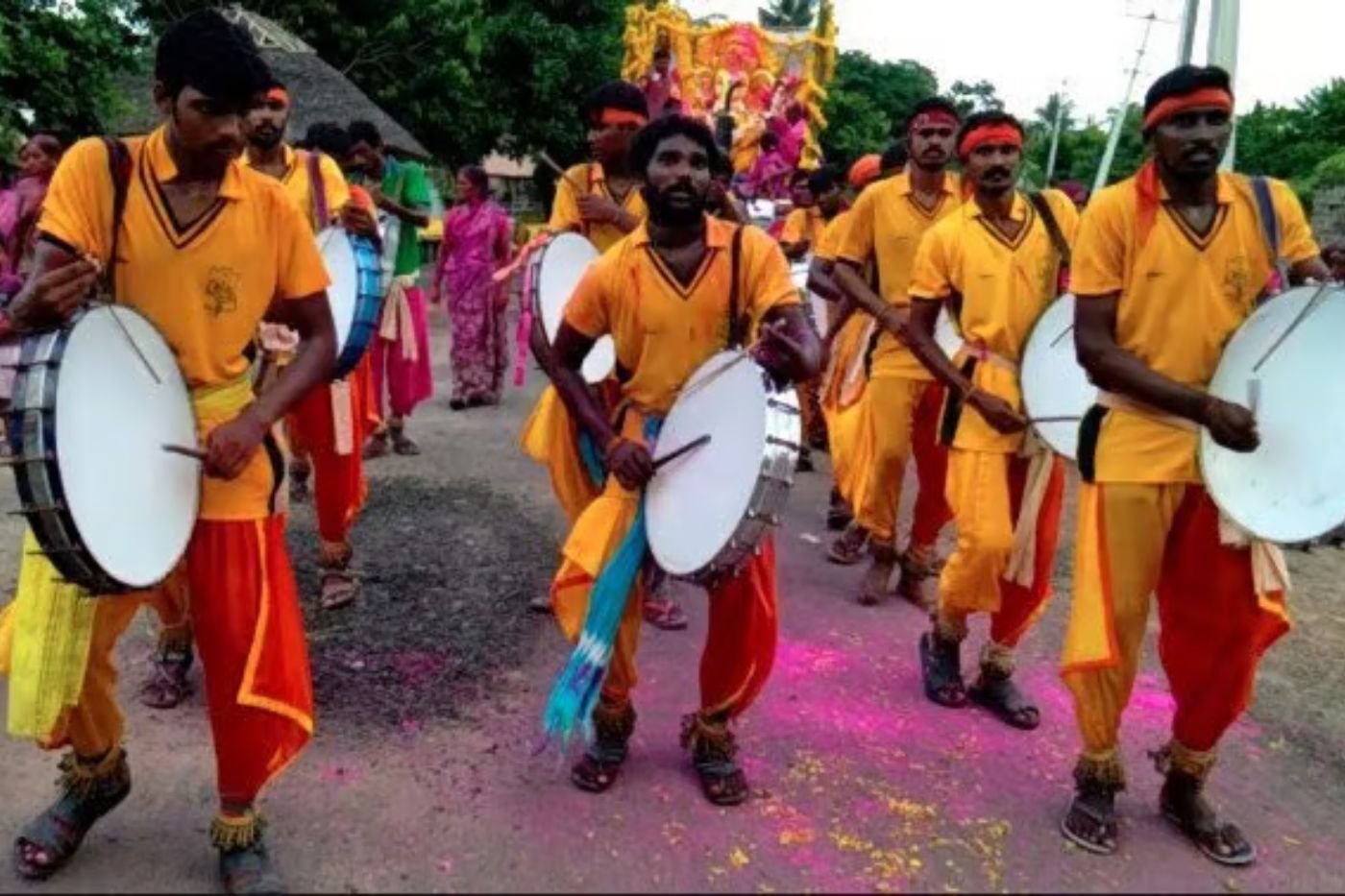
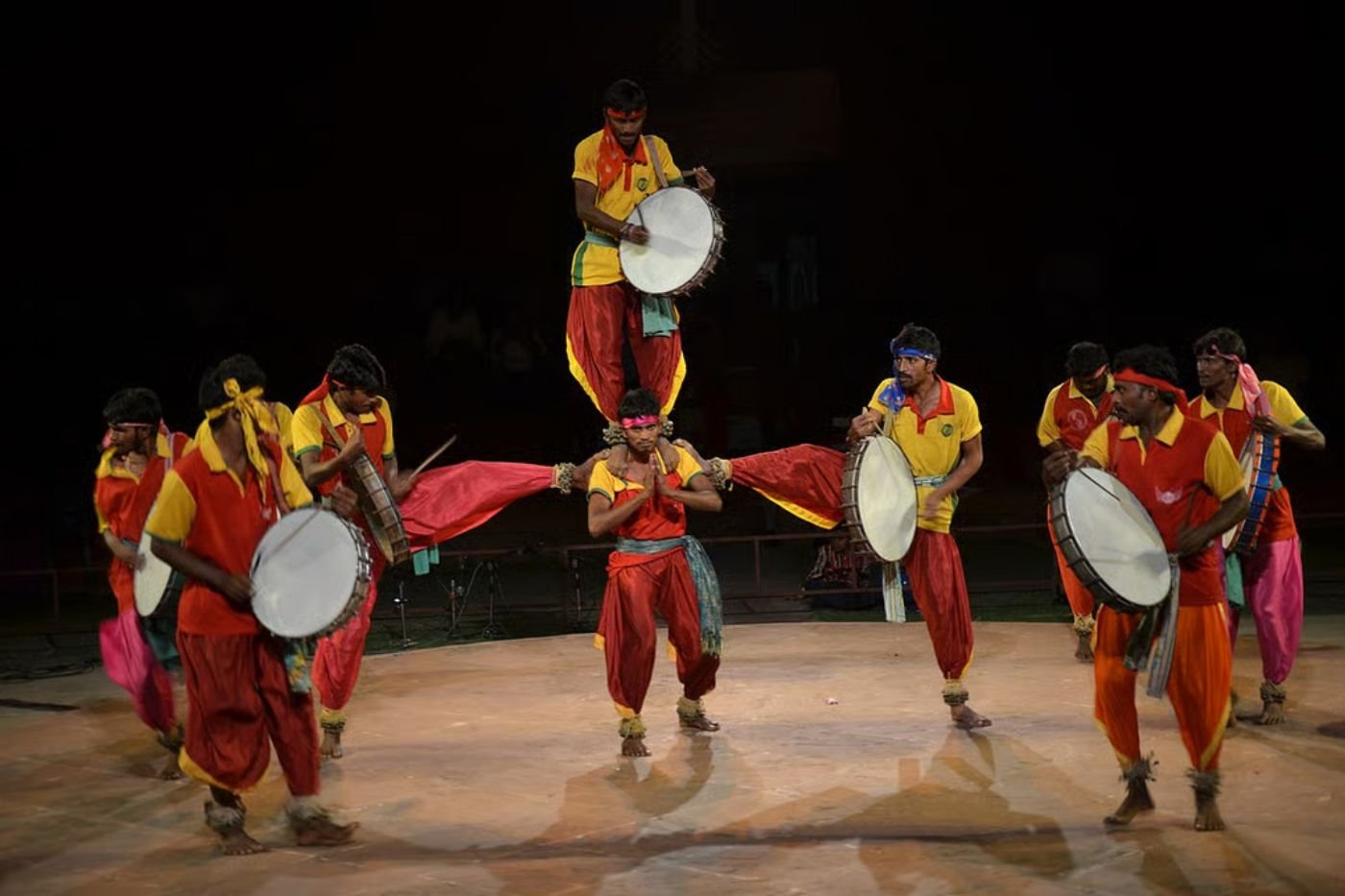
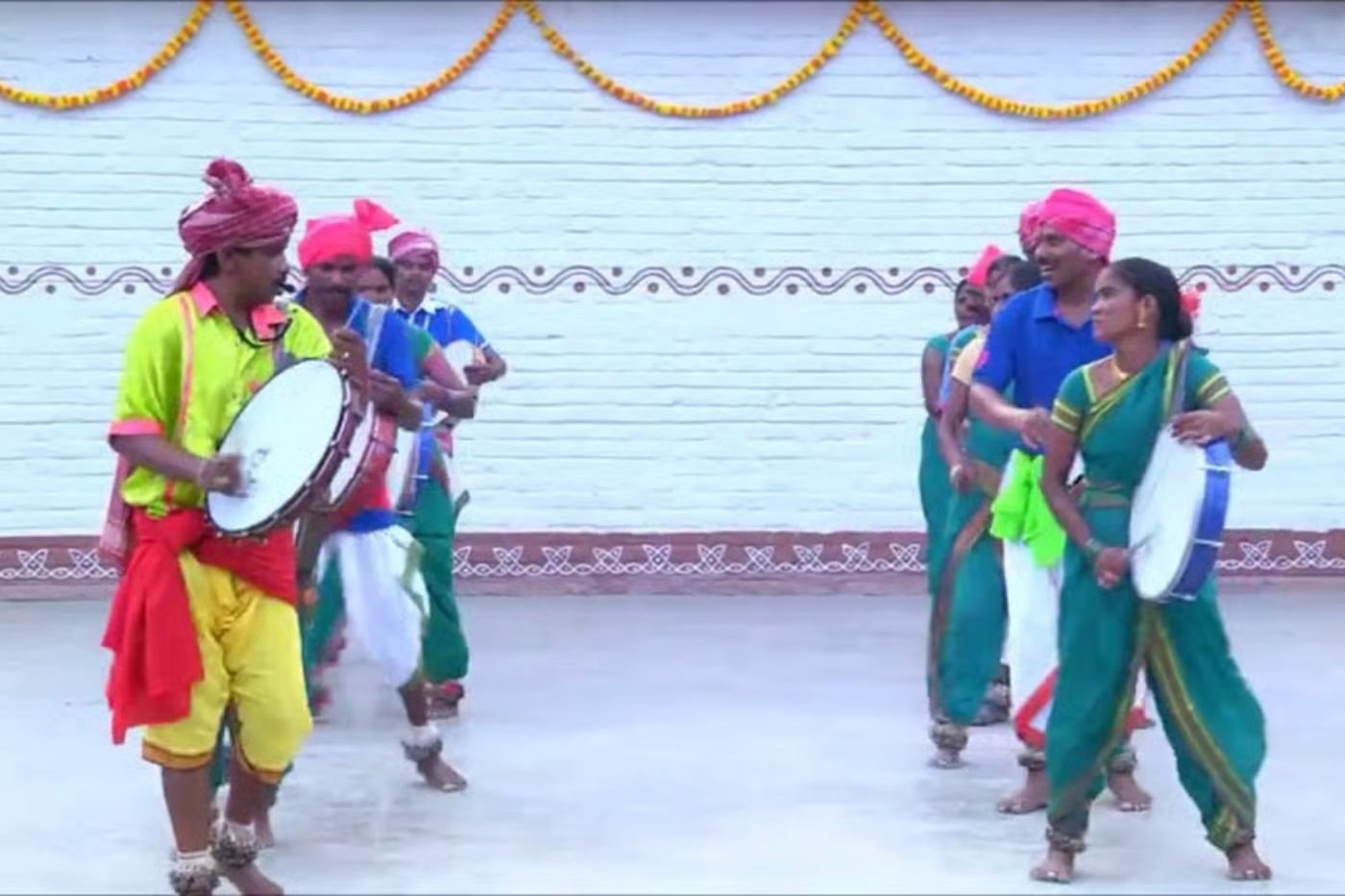
These images illustrate the Dappu tradition as documented by third parties. They are not photographs of our own artists, and we do not present them as such. For current images of the specific group you are booking, ask us and we will share what the troupe provides.
Where Dappu is performed — village festivals and modern events
Traditional settings
Documented accounts of the tradition place the dappu in the following settings:
- Village festivals and jataras — the local fair-and-festival calendar
- Festivals of the folk goddesses, where the drum is part of the ritual sound
- Weddings and household celebrations
- Processions, including funeral processions where the drum leads the route
- Seasonal celebrations such as the Dussehra period
In these settings the dappu is not entertainment placed at the edge of an event — it is the sound that carries the event from one place to another.
Where organisers use it now
On a modern programme, a Dappu group works wherever you need energy, movement and an unmistakably Indian folk sound:
- Weddings — baraat and entry sequences, sangeet, reception
- Corporate cultural days, town halls, product launches and brand activations
- College and school festivals, cultural competitions, annual days
- Cultural, tourism and craft festivals, melas and heritage programmes
- Government and institutional programmes, state-day and festival events
- Community celebrations, resident-welfare functions and destination events
Book a Dappu Dance performance for your event
We arrange folk performers for events across Delhi NCR and at outstation venues, and Dappu groups are part of that network. Tell us the date, the city and the kind of programme you are running, and our team will come back with the options that actually fit — subject to artist availability. We do not publish fixed prices, because a Dappu booking is priced per event.
What to send us for a useful quotation
- Event date and city — plus the venue if it is already confirmed
- Occasion and audience — wedding, corporate, college fest, cultural programme; and roughly how many people will watch
- Slot and duration — where in the programme the performance sits and how long it should run
- Group size — how many artists you want, or ask us to recommend a number for your venue
- Venue type — indoor or outdoor, and the usable performance area (a group with frame drums needs real space)
- Audio and stage — what sound and lighting the venue provides, and whether you need us to arrange it
- Context — whether you want an introduction or commentary for an audience unfamiliar with the tradition
- Budget range — so we shortlist within it rather than guessing
What affects the cost
Because there is no fixed rate, the quotation will depend on the number of performers, the city and travel involved, the date and duration, how many sets you want, whether live musicians travel with the group, and any stage, sound or costume requirements. Send the details above and we will tell you what is possible at your budget — clearly, before you commit.
Dappu Dance FAQs
What is Dappu Dance?
Dappu Dance is a Telugu folk dance performed by a group of dancers who each carry a dappu — a large round frame drum — and play it while dancing. The dance takes its name from the instrument. The drum sets the rhythm, tempo and choreography, so the performance builds and drops with the beat rather than following a separate band.
Is Dappu Dance from Telangana or Andhra Pradesh?
Both. It is a Telugu folk tradition documented in Telangana and Andhra Pradesh, and also present in parts of Tamil Nadu and Karnataka. One commonly repeated account links its origin to the Nizamabad district of Telangana, but the form has no reliably dated origin — descriptions of its exact age should be treated as attribution rather than record.
What is the role of the Dappu drum in the performance?
The drum is the performance. Instead of accompanying dancers, the performers play it as they move: rhythmic patterns called jatis drive the footwork, the formations and the pace of the whole group. The group strikes harder and faster to build intensity and pulls the beat back to settle the choreography, with ankle bells adding a second rhythmic layer underneath.
Where is Dappu traditionally performed?
Documented settings include village festivals and jataras, festivals of the folk goddesses, weddings, processions and funeral processions, and seasonal celebrations such as the Dussehra period. Today the same vocabulary is performed on city cultural stages, at state and institutional programmes, and at festivals and melas.
Can I book a Dappu Dance group for an event?
Yes — we arrange Dappu groups for weddings, corporate functions, college and school festivals, and cultural or government programmes. Availability depends on the date, city and how many performers you need, so send those three details first and we will confirm what can be arranged for your event.
What details should I send when I enquire?
Event date and city, venue (or venue type), the occasion, approximate audience size, the slot and duration you have in mind, how many artists you want, the usable performance area, what sound and lighting the venue provides, and your budget range. That is usually enough for us to shortlist realistic options in one reply.
How much does booking a Dappu group cost?
There is no fixed rate. Cost depends on group size, the city and travel involved, the date and duration, the number of sets, whether live musicians travel with the troupe, and any stage, sound or costume requirements. Share your event details and we will send a quotation — or tell us your budget and we will tell you what is achievable within it.
Enquire about a Dappu Dance performance
Fill in the four essentials and we will open a WhatsApp message to our bookings team with your details already written out. If you would rather talk it through first, call or message us directly — no lengthy form required.
Compose your enquiry
This opens WhatsApp with your details ready to send. Nothing is submitted until you press send there. Prefer to see it before sending? You can edit the message freely.
Or reach us directly
- WhatsApp +91 93550 56666Share date, city and occasion
- Call +91 93550 56666Bookings line
- Call +91 93199 77060Alternate booking line
- Contact pageForm, offices and directions
Not sure what you need? Send us the event date and city alone — that is enough for us to start.
Booking a Dappu group is subject to artist availability on your date. We will always tell you plainly what can and cannot be arranged.