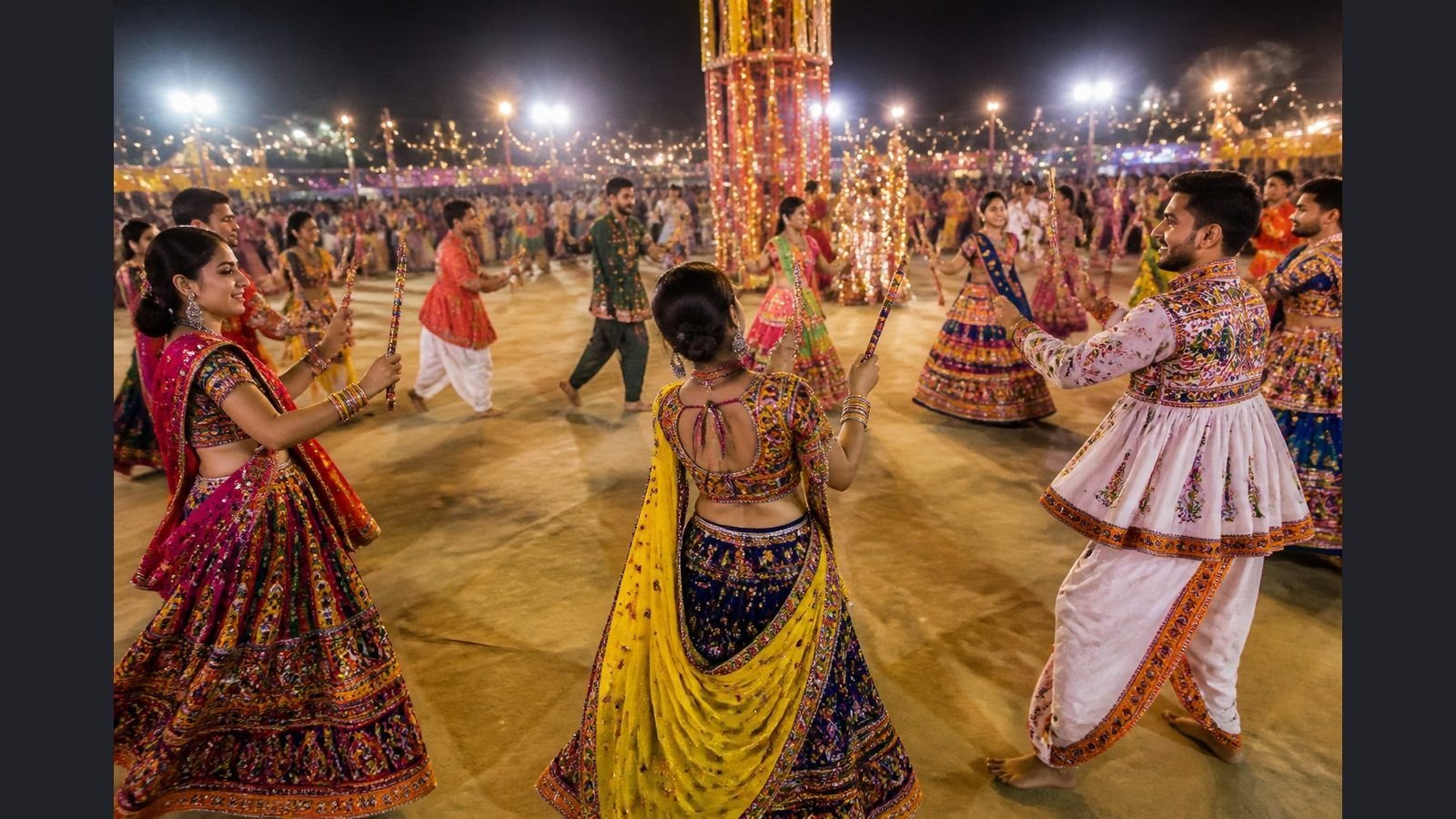
Dandiya Raas Dance of Gujarat
Dandiya Raas is Gujarat's joyful stick dance — pairs of dancers striking decorated wooden dandiyas to a driving rhythm, most famously during the nine nights of Navratri. On this page you'll find its story, costumes, music and steps, plus how to book authentic Dandiya Raas performers for your event.
What Is Dandiya Raas Dance?
Dandiya Raas is a traditional folk dance in which dancers hold a pair of decorated wooden sticks — called dandiyas — and strike them against their partner's sticks in time with the music. Dancers usually perform in pairs arranged in circles or facing rows, and the number of dancers is traditionally kept even so that everyone has a partner.
The dance is as much a social activity as a performance art. Men and women dance together, the rhythm builds as the circles turn, and each small formation change gives dancers a new partner to strike sticks with. Because the steps follow clear, repeating cycles, first-time participants can join in after a few minutes of watching — one reason the dance travels so well to festivals, weddings and community events outside Gujarat as well.
History and Cultural Significance of Dandiya Raas
Dandiya Raas is rooted in the folk traditions of Gujarat, where raas refers to dances performed in circles by groups of dancers. The name and the stick play are popularly traced to two traditions. The first links the dance to the Raas Leela — the stories of Lord Krishna dancing with the gopis of Vrindavan — where the dandiya sticks are said to mark the rhythm of that divine dance. The second connects the stick striking to the devotional dances of Navratri honouring Goddess Durga, with each clash of sticks recalling the clash of swords in the goddess's battle against the demon Mahishasura.
These origin stories are best understood as living traditions rather than recorded history — documentary evidence about exactly when and how the dance took shape is limited. What is well established is its place in community life: cultural references describe raas being performed not only during Navratri but also at fairs around Janmashtami, and different communities of Gujarat developed their own styles of raas over time.
From its devotional and community roots, the dance spread far beyond Gujarat. Today Dandiya Raas is a fixture of Navratri celebrations across India — from Mumbai and Delhi to Bengaluru and Patna — and among Indian communities worldwide, where it is performed both as worship and as celebration.
Dandiya Raas in Gujarat's Folk Culture
In Gujarat, Dandiya Raas belongs to a wider family of folk dances that includes the famous circular Garba, Tippani, Bhavai and many regional variations. Raas is the dance of celebration and togetherness — performed at village fairs, weddings, social gatherings and festival grounds, with each region and community adding its own formations, songs and style of stick play.
What makes the Gujarati presentation distinctive is the blend of devotion and social joy. Songs in Gujarati carry stories of Krishna and of the goddess, while the formations — circles that turn clockwise and anticlockwise, pairs that swap partners on the beat — keep everyone, young and old, part of one moving pattern.
Traditional Costumes and Dandiya Sticks
Women traditionally wear the chaniya choli — a flared three-piece outfit of skirt (chaniya), fitted blouse (choli) and dupatta — in bright colours with bandhani tie-dye, mirror work (abhla) and embroidered borders. Silver-style jewellery, bangles and waistbands complete the festive look.
Men traditionally wear the kediyu, a short kurta that flares at the waist and sleeves, paired with a dhoti or churidar, and often a turban or waistcoat depending on the region and community.
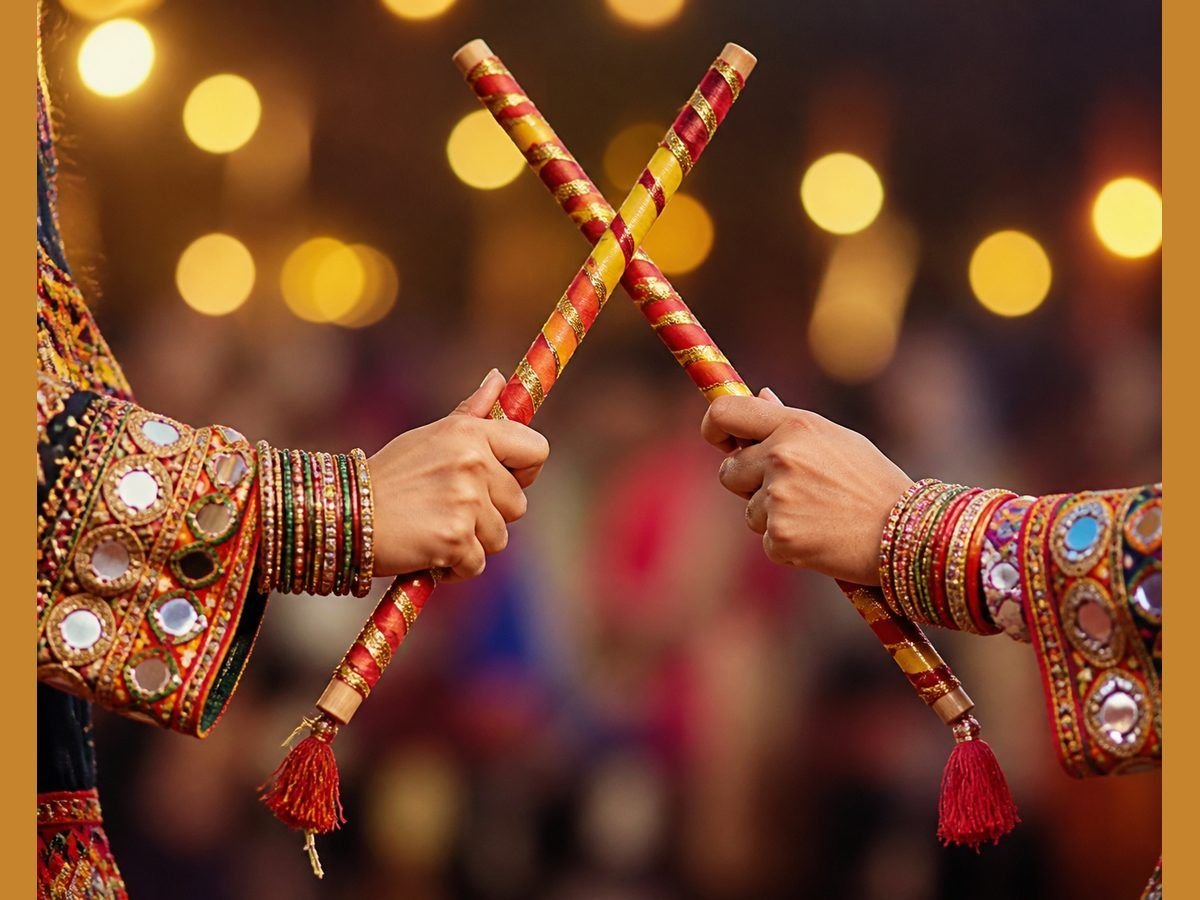
The dandiya sticks themselves are part of the costume: wooden pairs painted in bright colours and decorated with ribbons, mirror tape or small bells. Costumes vary across Gujarat's regions — and at modern events and stage shows, contemporary adaptations of these outfits are common, so the looks you see at a dandiya night may blend tradition with present-day style.
Music, Rhythm and Instruments
Dandiya Raas is danced to rhythmic Gujarati folk songs whose verses often tell stories of Krishna, the goddess or the monsoon season. The music is cyclic — repeating rhythmic cycles that the stick strikes and footwork lock into — and the tempo typically builds as the night goes on, lifting the energy of the circles.
Traditional accompaniment centres on percussion: the dhol and dholak carry the beat, supported by clapping, while instruments such as the harmonium, shehnai and flute carry the melody, and singers lead the verses. At contemporary events, live folk singers often share the stage with a DJ, so traditional raas melodies mix with high-energy fusion tracks — a format that works especially well for mixed-age audiences at dandiya nights.
Dandiya Raas Dance During Navratri
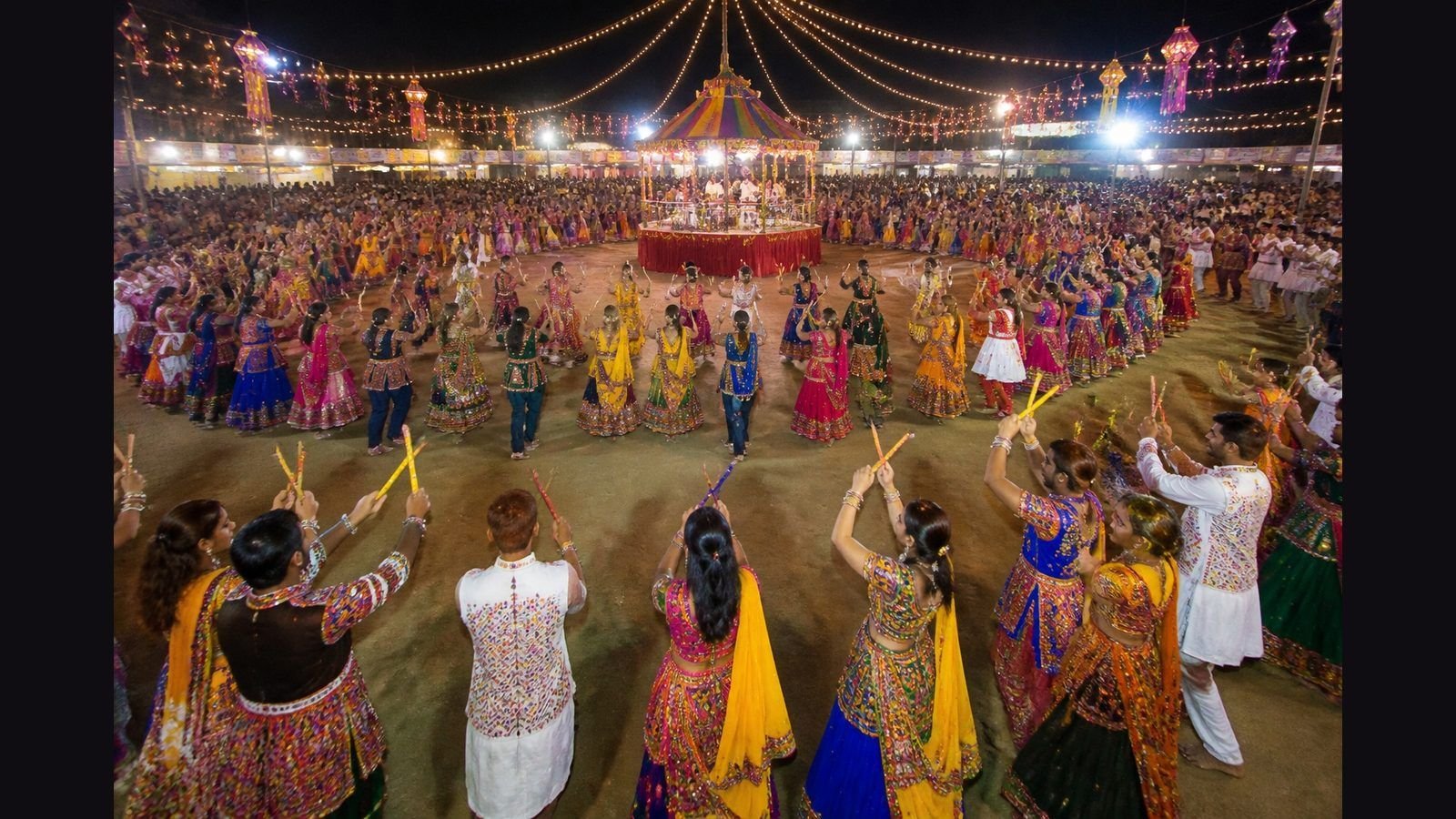
Navratri — the "nine nights" dedicated to Goddess Durga — is when Dandiya Raas truly comes alive. In Gujarat, communities gather each evening after the day's fasting and worship, often beginning with Garba around the garbo and moving into dandiya as the energy rises through the night.
The nine nights have a festive social rhythm of their own: families dress in their best traditional wear, grounds and pandals fill with circling dancers, and the final nights often run late with competitions and special performances. Outside Gujarat, cities with large Gujarati communities — Mumbai, Delhi NCR, Ahmedabad, Bengaluru, Pune and many more — host large ticketed dandiya nights, and housing societies, colleges and companies organise their own celebrations.
Dandiya Raas Dance Steps and Performance Style
The basic movement of Dandiya Raas follows a simple beat cycle that beginners can pick up quickly:
- Strike your own sticks together on the first beat, holding one dandiya in each hand.
- Strike your partner's sticks on the next beat, leaning slightly forward as you do.
- Step back and move on — in circle formations, dancers progress to the next person in the circle and repeat the cycle.
- Add turns and faster patterns as confidence grows, always keeping the stick strikes on the beat.
Stage and troupe performances build on this foundation with choreographed formations — concentric circles, facing rows, diagonals and partner swaps — timed to the music's build-up. Watching a skilled group is the fastest way to understand the structure: the sticks do the counting, and the feet simply follow. If you'd like this kind of guided experience at your own event, our performers routinely include a short step-teaching segment so that guests can join the circle too.
Dandiya Raas and Garba: What's the Difference?
Garba and Dandiya Raas are often mentioned together — and both light up Navratri — but they are distinct dances with different movements and conventions:
| Aspect | Garba | Dandiya Raas |
|---|---|---|
| Prop | None — danced with hands and claps | Pair of decorated wooden sticks (dandiyas) |
| Formation | Open circle around a lit earthen pot (garbo) or lamp | Pairs, or two concentric circles of partners facing each other |
| Movement | Flowing circular steps, swaying and clapping in place | Stick strikes between partners on the beat, with stepping and partner changes |
| Traditional emphasis | Devotional worship of Goddess Durga | Playful, energetic Raas — popularly linked to Krishna's Raas Leela |
Dandiya Raas Dance Performance for Events
A live Dandiya Raas performance brings colour, rhythm and instant audience participation to almost any celebration. Our performers present the dance in traditional costume with coordinated choreography, and the format can be adapted to your venue, audience and programme:
Navratri Celebrations
Feature performances and full-evening dandiya programmes for societies, clubs and community Navratri events.
Cultural Festivals
Stage presentations that showcase authentic Gujarati folk dance at fairs, festivals and institutional celebrations.
Weddings & Sangeet
Festive dandiya sets for sangeet, mehendi and wedding receptions — a favourite with Gujarati families.
Corporate Events
Navratri week celebrations, employee engagement evenings and brand events with stage-managed performances.
College & Community Events
High-energy dandiya for college fests and community gatherings, with step teaching that gets everyone dancing.
Private Gatherings
Compact performances for family functions, birthdays and festive parties at home or in banquet spaces.
Performances can be planned as a short feature act or a longer interactive set with audience participation, and group size can be matched to your stage. For related formats, see our Garba dancer groups, Navratri dancers and college fest dance performances.
Book Dandiya Raas Dance Performers
Tell us about your event and we'll suggest the right lineup — from a small traditional group to a full evening troupe — then handle the coordination so you don't have to chase multiple vendors.
Event date, city and venue, audience size, programme slot and the kind of performance you have in mind.
We shortlist Dandiya Raas performers and groups to match your venue, duration and budget, and confirm availability.
We coordinate arrival, sound check and stage timing, so the performance simply happens on the night.
Frequently Asked Questions
What is Dandiya Raas dance?
Dandiya Raas is a traditional folk dance of Gujarat in which dancers in pairs strike decorated wooden sticks called dandiyas in rhythm, moving in circles or rows. It is performed mainly during Navratri and is known for its energy, coordination and festive community spirit.
Where did Dandiya Raas originate?
Dandiya Raas comes from Gujarat. Popular traditions link its origin to the Raas Leela of Lord Krishna with the gopis of Vrindavan, while another widely told tradition connects the stick play to the devotional dances of Navratri honouring Goddess Durga. Documented history is limited, so these origin stories are best understood as cultural traditions rather than recorded history.
Why is Dandiya Raas performed during Navratri?
Navratri, the nine-night festival dedicated to Goddess Durga, is the traditional season for both Garba and Dandiya Raas in Gujarat. The dance is part of the devotional and festive celebration, and over time it has also become a highlight of Navratri events and community gatherings across India.
What is the difference between Garba and Dandiya Raas?
Garba is performed in a circle around a lit earthen pot or lamp, without props, with flowing clapping and circular steps. Dandiya Raas is performed in pairs or facing rows using decorated wooden sticks, struck against a partner's sticks on the beat. The two dances are often performed at the same Navratri event, but their movements and conventions are different.
What costumes are worn in Dandiya Raas?
Women traditionally wear a chaniya choli — a flared skirt and fitted blouse with bandhani prints, mirror work and a dupatta — while men wear a kediyu, a flared kurta, with dhoti or churidar and sometimes a turban or waistcoat. The wooden dandiya sticks are decorated with paint, ribbons or bells. Modern stage and event performances often use contemporary variations of these outfits.
What are the basic Dandiya Raas dance steps?
The basic pattern is built on a four-beat cycle: dancers strike their own sticks, then their partner's sticks, adding steps and turns as they grow confident. Dancers stand in pairs or concentric circles, keep the rhythm with their feet, and progress around the circle. Live demonstrations by performers and instructors make the pattern easy to pick up at events.
How can I book Dandiya Raas dancers for an event?
Share your event date, city, venue, audience size and the type of performance you have in mind through our contact page, phone or WhatsApp. Our team suggests suitable Dandiya Raas performers or groups, confirms availability and coordinates the performance for your Navratri celebration, cultural programme or festive event.
Cultural background on this page reflects widely shared traditions and published cultural references about Dandiya Raas; origin stories are presented as traditions, not documented history. Performance availability, group sizes and formats are confirmed per event through our team.