Goan Folk Heritage · Konkani Song & Dance
Dekhni Dance of Goa
Grace, gold jewellery and lamp-lit song from Goa’s Konkani stage tradition
The Dekhni dance of Goa is a semi-classical Goan dance form performed by women, usually in a nine-yard nav-vari saree with gold jewellery and anklets, moving to Konkani songs set to Western-style music. Its best-known song tells of temple dancers persuading a ferryman to row them across a swollen river — a story danced and sung rather than simply staged.
Enquiries go to the site’s existing contact page. Availability, troupe size and pricing are confirmed individually — this page does not quote fixed rates.
Quick answer
What Is the Dekhni Dance of Goa?
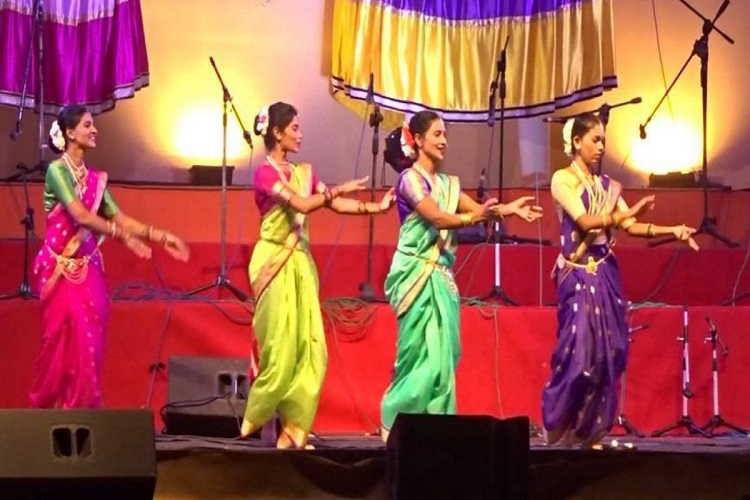
Dekhni (also spelt Dekhnni, Dekni or Dekhṇi) is a semi-classical dance form from Goa, and one of the state’s oldest surviving folk traditions. Its name is commonly explained from the Konkani word for beauty or grace — the dance was named for the quality of its movement. It blends elements of Indian classical dance with Western-style music and is performed by women in traditional Goan dress, with the main dancers often carrying small oil lamps as they dance.
Dekhni at a glance
- Form
- Semi-classical Goan dance, performed as song-and-dance rather than pure mime
- Region
- Goa, in coastal western India; performed across the state, with a strong presence in Catholic and Hindu communities
- Performed by
- Women, typically a lead dancer with a supporting group
- Language of the songs
- Konkani
- Musical accompaniment
- Western-style chorus singing; sources describe the ghumot (an earthen folk drum), guitar and violin
- Costume
- Nine-yard nav-vari saree, flowers in a hair bun, gold jewellery including a nath (nose ring), and ghungroos (ankle bells)
- Props
- Small oil lamps (often described as divzas or pantees) carried by the dancers
These attributes describe Dekhni as it is documented in Goan and encyclopaedic sources. A troupe’s actual staging — ensemble size, lamp props, live versus recorded music — varies by group, so confirm specifics with the performers when you plan an event.
History & origin
History and Origin of the Dekhni Dance
The history of the Dekhni dance reaches back roughly 150 years, into nineteenth-century Goa, and it developed in a society where Indian and Portuguese cultural worlds overlapped for centuries. That blended setting is exactly why the dance’s origins are still argued over rather than settled: scholars do not agree on a single account of where Dekhni began.
Three documented theories
- Temple dance ancestry: one view traces it to dances performed by Devadasi women in front of temple palanquins.
- Portuguese cultural influence: another attributes the form’s development to Portuguese rule and its cultural pressures.
- Deliberate fusion: a third holds that Dekhni was created by combining Indian dance styles with Western music to entertain Portuguese officials.
We present all three because no single one is established beyond debate. Treat any confident “Dekhni was invented in year X by person Y” claim — including on this site’s competitors — with caution.
Classical borrowings and Western sound
The dance’s movement language is credited with elements borrowed from classical Indian traditions, with Kathak and Bharatanatyam most often cited, set against the rhythm and chorus singing of Western music. Dekhni is also counted among the Konkani musical forms — alongside mando and dulpod — that grew out of Goan interaction with Western music.
Written accounts of the dance treat it as an old form with a relatively small surviving repertoire of songs; only a handful of older dekhni compositions are still commonly performed today.
The song that carried Dekhni beyond Goa
Dekhni’s most famous composition is Hanv Saiba Poltoddi Voitam (“I am crossing to the other side of the river”) by the Goan composer Carlos Eugénio Ferreira. It was first published in Paris in 1895 and then in Goa in 1926, and it travelled far beyond the Konkani stage: Raj Kapoor adapted it as Na mangoon sona chandi in the Hindi film Bobby. Its reach is part of why a Goan riverside dance form is still recognised by audiences with no Konkani at all.
An early dekhni, Kuxttoba, is dated to around 1869 and carries a very different tone: its lyrics describe Kuxttoba as “heir to India and terror of Goa”, which reads as resistance to Portuguese rule. It is a useful reminder that Dekhni has been used for more than entertainment — the form has carried social and political comment too.
Looking for the wider picture on Goan folk performance? Our Goa folk dance troupe page covers the state’s dance traditions as a whole, including forms performed alongside Dekhni.
Meaning & storytelling
Cultural Significance and the Story Behind the Dance
Dekhni is not an abstract display of technique; it is a narrative form. The strand running through its best-known songs is the life of the Devadasi — a woman dedicated to temple service, who danced at temples and at social ceremonies such as weddings. That social world is the subject of the dance, which is why the songs carry so much of the meaning.
A temple dancer needs to cross the river to dance at a wedding. She calls to the boatman; he refuses, because the water is rough. She offers her gold jewellery. He still refuses — so the dancers dance for him, and this time he ferries them across.
The story of Hanv Saiba Poltoddi Voitam, danced and sung rather than narrated.
Two features make Dekhni distinctive as cultural heritage. The first is who performs it: Dekhni is described as a dance of women, and Goan sources record both Hindu and Christian women taking part — a detail that reflects Goa’s unusually layered religious and social history. The second is the intertwining of art forms: a Konkani song tradition, Indian classical movement vocabulary and Western musical accompaniment all sit inside one performance.
For event organisers, that combination is the practical value of a Dekhni performance: it is recognisably Goan, it is a song-and-dance piece rather than a silent routine, and it can be presented with enough context for an audience that has never seen it before.
Reading the record carefully. Where the history is genuinely disputed, we say so. We do not repeat unverifiable origin stories, invented dates or claims about religious practice that Goan and encyclopaedic sources do not support — and we do not present modern stage costumes as historical dress.
Sound
Dekhni Dance Music and Singing
Dekhni is a song form as much as a dance form. Performers move to Konkani songs built on a blend of Indian melody and Western rhythm, and the impression most audiences take away is of a conversation carried in music — the exchange between the dancers and the boatman is sung.
Instruments described in the sources
- Ghumot — an earthen Goan folk drum associated with the dance’s rhythm.
- Guitar — part of the Western-influenced accompaniment.
- Violin — likewise carried into the Goan rendition of the form.
Line-ups differ between troupes and between live and recorded presentations. Treat this as the documented core, not a fixed specification.
What accompanies the words
Accounts of Dekhni describe Western-style chorus singing and percussion carrying the song, with the dancers’ footwork locked to that rhythm. Several older dekhni songs are named in the record — among them Arê tanddela, Tendulechim tendulim, Vaingem kazar zata mhunn, Voddekara, Vhoir vhoir dongrar and Xeutim mogrim abolim.
Because the repertoire is old and finite, a troupe’s programme is usually a small set of traditional songs, sometimes framed by commentary for audiences outside Goa.
If your event needs recorded music, live musicians or a bilingual introduction, say so in your enquiry — those decisions change the stage plan, the sound requirements and the preparation time entirely.
Dress & props
Dekhni Dance Costume and Props
Descriptions of Dekhni dress are consistent on the essentials: a nine-yard nav-vari (also written nav-vari kashta) saree, flowers in a hair bun, and traditional gold jewellery, including a nath — the nose ring — and ghungroos, the ankle bells that mark the dancer’s footwork. The lamps carried during the dance are a defining visual detail of the form.
- Saree: nine-yard nav-vari drape, in bright silks with contrast blouses
- Hair: bun dressed with fresh flowers (gajra)
- Jewellery: nath, earrings, layered necklaces, bangles and arm ornaments
- Feet: ghungroos (ankle bells), with the dance generally performed barefoot on stage
- Props: small oil lamps — divzas or pantees, the floating-wick clay lamps described in Goan accounts
A practical caveat for organisers: what appears on a modern stage is a production of Dekhni, not a museum reconstruction. Troupes vary the drape, the fabric, jewellery weight and lamp design to suit stage safety and lighting, and some use a shorter saree for practical reasons. If costume accuracy matters for a heritage or documentation-led programme, tell the performers in advance and ask them to confirm what they will wear.
On stage
How a Dekhni Dance Performance Works?
The clearest way to describe a Dekhni performance is as a song cycle that unfolds in layers. One woman begins the dance, and the others join as it continues — the group grows into the piece rather than opening at full strength. Within that group there is usually a principal dancer carrying the expression and the dialogue, with the rest of the ensemble supporting her in unison movement.
Movement and expression
- Graceful, restrained body carriage with descriptive hand gestures rather than sharp athleticism
- Footwork and expressions that act out the song’s words, including the exchange with the boatman
- Elements attributed to classical Indian dance traditions, with Kathak and Bharatanatyam most often named
- Lamps held by the main dancers, which constrains and shapes the movement and is part of the visual identity of the form
What that means for staging
- A clean, dark-ish stage reads best — the lamps and jewellery carry the visuals
- A level performance floor is essential when barefoot dancers are moving with lamps
- Sound matters as much as space: the piece is carried by sung Konkani lyrics
- A short spoken or written introduction helps audiences outside Goa follow the story
Exact running times, ensemble sizes and choreographic detail are troupe-specific. We do not publish a standard “Dekhni package” — ask, and the performers confirm what they can stage for your venue.
Programmes
Dekhni Dance Performances for Events
Dekhni works best where an audience has a moment to watch rather than a crowd moving past. It suits seated programmes, cultural segments with a defined slot, and occasions where Goan or Indian heritage is the point of the evening. Typical settings organisers ask about:
Cultural & heritage programming
- Cultural festivals and Indian cultural programmes
- Tourism and heritage events featuring regional traditions
- College cultural festivals and inter-college events
- Stage shows and themed evenings built around a region or state
Private & corporate functions
- Corporate cultural celebrations and annual-day programmes
- Wedding-related cultural segments, including Goan-themed weddings
- Hotel, resort and destination-event cultural slots
- Community and association functions with a folk-performance segment
Two honest points. First, suitability depends on your audience and slot length: Dekhni is a song-driven, lamp-lit piece, so it lands better in a quiet, seated cultural segment than as background entertainment during a moving crowd. Second, availability is always confirmed for your date and city — this page cannot promise a specific troupe on a specific day.
If your programme needs more than one folk form, the wider folk dances of India section covers what else can be combined with a Goan segment, and our performance gallery shows how such segments are usually staged.
Book Dekhni folk dancers
Enquire About Dekhni Folk Dancers for Your Event
Send us your event brief through the site’s contact page and we will come back to you with what is genuinely possible for your date, venue and programme — including which troupe can travel to you and what the performance would include.
Details that help us respond properly
- Event date (and your preferred time slot)
- Event city and venue, with the stage or performance area available
- Type of event — festival, corporate function, wedding, college fest, heritage show
- Approximate audience size and whether seating is fixed or informal
- Performance duration you have in mind for the cultural segment
- Stage size and height, flooring, and entry/exit access for the performers
- Music requirement: live musicians, recorded tracks, or a mix
- Number of performers you are expecting, if you already have a figure
- Budget range, if you are comfortable sharing one
Prefer to talk it through? The call and WhatsApp buttons on this site connect you to the same booking desk. We do not publish fixed Dekhni pricing or confirm availability in advance of an enquiry — both depend on your date, city and programme.
Choosing well
Choosing a Suitable Dekhni Dance Performance
Because Dekhni troupes differ in size, repertoire and staging, the useful question is not “which is the best” but “which performance fits this programme”. These are the criteria that actually change the result:
Fit with the occasion
- Cultural suitability — is a Goan or Konkani segment meaningful to this audience, and does it need context?
- Slot length — a heritage segment and a wedding crowd need different running times
- Placement in the programme — Dekhni rewards attention, so place it where the audience is seated and settled
Fit with the venue
- Stage size and floor — barefoot movement with lamps needs a safe, level surface
- Lighting and sound — sung lyrics must be audible; the lamps read best in lower ambient light
- Logistics — travel, green-room space, changing area and costume handling for outstation shows
- Coordination — one point of contact for timing, sound check and stage cues
We keep the process to one brief, one clarification round and one confirmed plan — see artist coordination services for how bookings are handled end to end, or wedding artist booking and corporate event artists if your cultural segment sits inside a larger function.
Performance archive
Goan Folk Dance Performances in Pictures
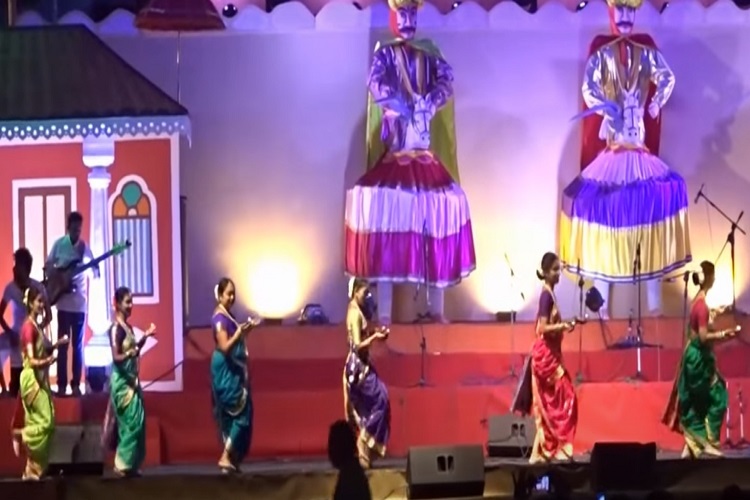
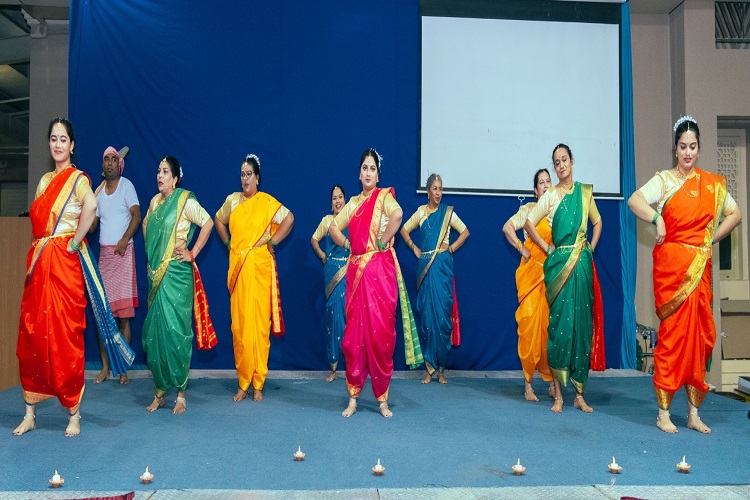
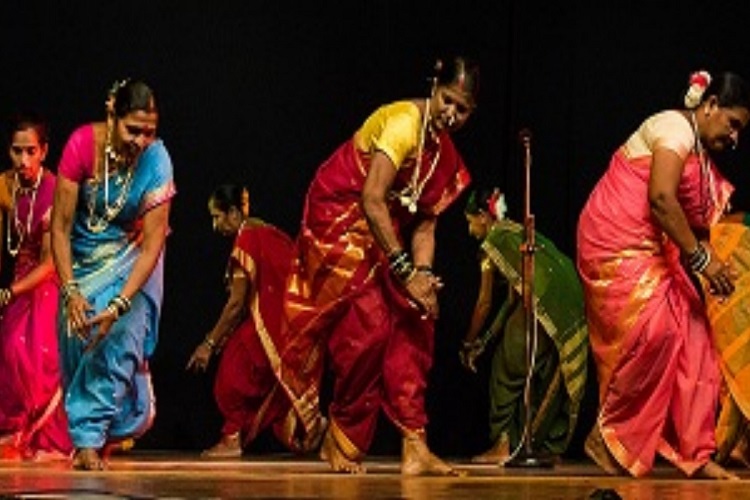
These are photographs from our own performance archive, captioned by what is visible in each frame. Troupes stage Dekhni with variations in costume and ensemble size, so treat them as representative of a Goan folk dance presentation rather than as a documentary record of one fixed format.
Questions
Frequently Asked Questions About Dekhni Dance of Goa
What is the Dekhni dance of Goa?
Dekhni is a semi-classical Goan dance form, and one of Goa’s oldest surviving folk traditions. It is performed by women, usually in a nine-yard nav-vari saree with traditional gold jewellery and anklets, to Konkani songs that blend Indian melody with Western-style music and chorus singing. The main dancers often carry small oil lamps as they perform.
What is the history and origin of Dekhni dance?
Its history is generally placed around 150 years back, in nineteenth-century Goa. The origin is disputed: sources suggest temple dance by Devadasi women in front of palanquins, the broader cultural influence of Portuguese rule, or a deliberate fusion of Indian dance with Western music created to entertain Portuguese officials. An early dekhni, Kuxttoba, is dated to about 1869 and carries anti-colonial sentiment. No single origin account is agreed, so confident single-answer claims should be treated with caution.
What costume and props are used in a Dekhni performance?
Documented descriptions point to a nine-yard nav-vari saree, flowers in a hair bun, and traditional gold jewellery including a nath (nose ring) and ghungroos (ankle bells), with small oil lamps — divzas or pantees — carried by the main dancers. Contemporary stage productions vary the drape, fabric and lamp design, so it is worth confirming the exact costume with the troupe if accuracy matters to your programme.
What music accompanies Dekhni dance?
Dekhni is a song-and-dance form rather than a silent routine. Goan sources describe the ghumot, an earthen folk drum, alongside guitar and violin, with Western-style chorus singing carrying Konkani lyrics. The most famous song is Hanv Saiba Poltoddi Voitam by Carlos Eugénio Ferreira, published in Paris in 1895 and later adapted for Hindi cinema. Musical line-ups vary by troupe, so live versus recorded music should be decided through the enquiry.
Is Dekhni the same as Fugdi or other Goan folk dances?
No — they are distinct forms with different histories, rhythms and staging. Dekhni is a song-driven, semi-classical piece with lamp props and Western-influenced accompaniment; other Goan traditions such as Fugdi are separate dances with their own character. If you need more than one Goan form in a single segment, say so and the programme can be planned as a set.
Can Dekhni folk dancers be booked for cultural events?
Cultural festivals, heritage and tourism events, corporate cultural celebrations, college festivals, themed stage shows and wedding cultural segments are the settings where this dance form is most often requested. Whether it can be arranged for your date and city depends on performer availability and the nature of your programme, so it is confirmed after an enquiry rather than in advance.
How do I enquire about a Dekhni dance troupe?
Use the contact page to share your event brief, or reach the booking desk through the call and WhatsApp buttons on this site. A short written brief with date, city, venue and slot length is enough to start.
What details should I provide when requesting a performance quotation?
Event date and time slot; city and venue, including the stage or performance area; the type of event; approximate audience size; the duration you have in mind; music requirements (live or recorded); the number of performers you expect if you already know; and a budget range if you are comfortable sharing one. These details are what allow a realistic quote instead of a generic one.