Andhra Pradesh · Tribal Folk Dance
Dhimsa Dance of Andhra Pradesh
Dhimsa is the tribal circle dance of the Araku Valley and the hill tracts of the Eastern Ghats — a linked chain of dancers moving as one to drums and a horn, kept alive by the Porja and neighbouring Adivasi communities of Alluri Sitharama Raju district. It is danced at festivals, weddings and harvest gatherings, and today it is also staged for visitors, for state celebrations and for cultural events across India.
This guide explains what Dhimsa is, where it comes from, who dances it, what the dancers wear and how the music works — and how to enquire about a Dhimsa performance for your event.
Availability, group size and pricing are quoted per event — see how to book a Dhimsa dance group.
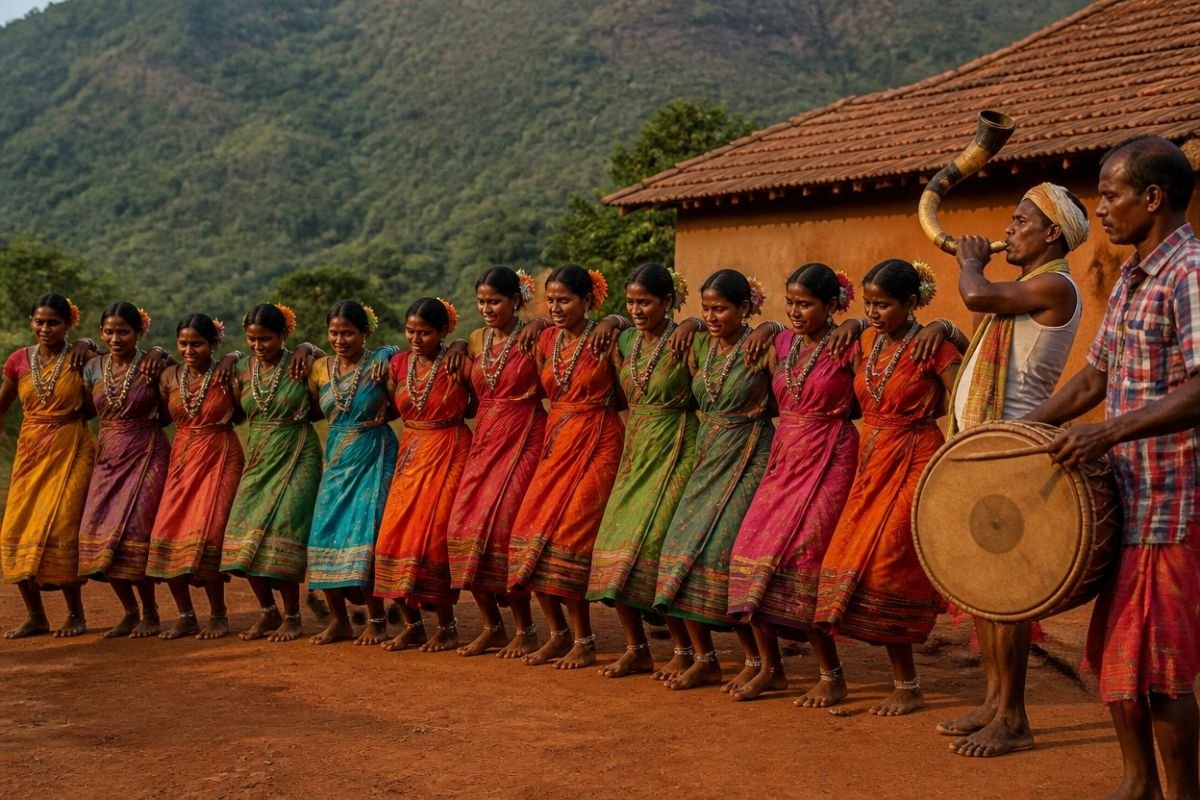
Dhimsa Dance at a Glance
Key facts
- What it is
- A tribal folk chain and circle dance. The name is usually explained as echoing the sound of dancing footsteps.
- Where it belongs
- The Araku Valley and the agency hill tracts of Alluri Sitharama Raju district, Andhra Pradesh, with roots across the border in the Koraput region of Odisha.
- Who performs it
- Most strongly associated with the Porja (Poraja) communities, and danced by several other Adivasi communities of the Araku and Paderu hills.
- Who dances, who plays
- Typically a group of about 15 to 20 women dance in a chain or circle; the instruments are usually played by men.
- Main instruments
- Tudumu (large drum), dappu (frame drum) and mori (horn), with smaller percussion such as kiridi.
- When it is danced
- Festivals — especially the March–April season — weddings, harvest and hunting festivals, and community gatherings.
- Variations
- Traditionally counted as twelve, each with its own occasion and steps; the exact list varies between villages and sources.
- Best-known record
- 13,102 participants set the Guinness World Record for the largest Dhimsa dance at Bhogapuram, Andhra Pradesh, on 31 July 2026.
What Is Dhimsa Dance?
Dhimsa is a group folk dance in which the performers do not face an audience in rows — they join themselves into a chain. Dancers link arms, or rest their hands on each other's shoulders, and move together in a line that curves into circles of different sizes. The rhythm is carried by drums, a horn cuts across them, and the whole chain steps, sways, bends and stamps as one body.
What makes Dhimsa distinctive is that it is a shared, participatory dance rather than a staged performance. It belongs to the Adivasi communities of the Araku Valley and the surrounding agency hills of Alluri Sitharama Raju district in Andhra Pradesh, and it is traditionally danced by women while men supply the music. Groups of roughly fifteen to twenty women are typical, though the number is not fixed — at the 2026 record attempt the dance was performed in hundreds of circles at once.
The movement vocabulary is drawn from hill life. Documented accounts describe steps that echo picking leaves and plants, sowing and farming, the rituals around marriage alliances, and even the gestures of guarding the village from wildlife. That is why the dance reads as more than entertainment: it is a record of daily work and belief, set in motion.
Dhimsa is closely related to the tradition called Dhemsa in the Koraput region of southern Odisha, and it is one of the best-known traditional dance forms of Andhra Pradesh — you will find it listed alongside the state's other folk dance traditions of Andhra Pradesh.
Planning a cultural programme?
Tell us your date, city and audience and we will come back with availability and a customised quotation for a Dhimsa dance group.
History and Origin of Dhimsa Dance
Dhimsa is older than the state border it now straddles. Its origins are usually traced to the Koraput hills of what is today southern Odisha, and it is understood to have travelled with the hill communities into the Araku Valley and the agency tracts above Visakhapatnam. In those hills it became so much the signature dance of the region that it now functions as a cultural emblem of the area.
The name itself is a description of the sound. Dhimsa is commonly explained as echoing the sound of dancing footsteps — an onomatopoeic name for a dance whose whole character is in the stamp and step of a group moving together.
Historically, Dhimsa was danced in two settings: as a festive and ceremonial dance at festivals, weddings and harvest celebrations, and as relief during working hours, when groups paused in the fields or forest and danced to break the rhythm of labour. Earlier accounts note that unmarried youth used to dance, and that there was no restriction on who could join in.
From village ground to state symbol
Through the twentieth century Dhimsa moved outward from the villages. It appeared at district fairs, at state cultural festivals and in Republic Day parades. The tribal welfare administration began teaching it in its residential schools, which is how tens of thousands of schoolchildren in the agency areas now learn the dance formally as well as at home. Araku's growth as a tourism destination added a further stage: the dance is now presented regularly to visitors in the valley.
That long arc reached a national milestone on 31 July 2026, when the Department of Tribal Welfare, Government of Andhra Pradesh, assembled 13,102 dancers at Alluri Sitarama Raju International Airport in Bhogapuram to set the Guinness World Record for the largest Dhimsa dance. It was a village circle dance performed at an unprecedented scale — and a striking statement of how far the tradition has travelled from the hill ground it grew out of.
Where historical detail is uncertain, it is worth saying so plainly: the tradition was carried by communities with a rich oral culture rather than written records, so accounts of its earliest form are based on regional tradition, folklore and later documentation rather than dated historical evidence.
Dhimsa Dance of Araku Valley
If one place is the home of Dhimsa in the popular imagination, it is the Araku Valley. The valley sits in the Eastern Ghats of Alluri Sitharama Raju district, close to the Odisha border, and it is here that the dance is most closely identified with the local hill communities. The district administration describes Dhimsa as the most famous cultural expression of the Araku Valley hill tribes.
For visitors, Dhimsa is not only a festival event. Regular performances are hosted at tourism hotspots in the valley so that travellers can see the dance in person, and the Araku Tribal Museum — which documents the lifestyle and artefacts of more than seventeen indigenous tribal societies of the Eastern Ghats — includes the region's performing arts among its displays. A daily evening performance has become part of the valley's visitor circuit.
When to see it in the valley
Dhimsa is danced most often in the festival season, particularly around March and April, and at harvest and hunting festivals such as Itika Pongal, which is celebrated with great energy across the agency tracts. The valley's biggest cultural gathering is the annual Araku Chali Utsav, a multi-day winter festival held between January and February that brings together folk art from several states along with tribal crafts, food and sports. If you are planning travel around Dhimsa, that festival window is the most reliable time to see large-scale performances.
The dance also lives beyond the valley. Because Dhimsa crosses the Andhra Pradesh–Odisha border, the same tradition is found in the Koraput hills, where it is known as Dhemsa — useful context if you are researching the dance and find sources that place its origin in Odisha rather than Andhra Pradesh. Both are describing the same border-country tradition, and you can see how it sits within the dance traditions of Odisha.
Which Tribe Performs Dhimsa Dance?
This is the question most often asked about Dhimsa, and the honest answer is that no single community owns the dance. Dhimsa is best understood as a shared tradition of the Araku and Paderu hills — a common cultural language between communities that farm the same hills, attend the same markets and marry across villages. At a large festival, chains from different villages dance side by side.
The community most strongly associated with the dance is the Porja (Poraja). Porja women's Dhimsa is the version most visitors see, and it is the association most often repeated in cultural and government descriptions of the dance.
Alongside the Porja, the communities most consistently named in accounts of Dhimsa include the Bagata, Valmiki, Khond, Kotia and Gadaba communities of the Araku and Paderu hills, together with Kondadora, Mukadora, Jatapu and Konda Savara communities across the Andhra Pradesh–Odisha border country.
Sources differ on the exact number of participating communities — some name a handful, while others describe nearly eighteen communities of the Paderu agency region as dancing it. That variation is itself informative: it reflects a living tradition rather than a fixed register. It would be inaccurate to claim that every tribal community in the region performs an identical form, and equally inaccurate to credit the dance to one community alone.
The distinction matters if you are briefing a performance. A Dhimsa group drawn from the Araku hills will present the dance as their own community tradition; the specific variety performed, the songs sung and the dress worn can all differ from village to village and from one community's version to another.
Dhimsa Dance Steps and Performance Style
Dhimsa is dominated by the movement of the feet and hands of a group dancing in formation. There is no single canonical sequence of steps — the tradition is passed on by participation, and different villages and varieties use different patterns. What can be described accurately is the structure that the documented varieties share.
- The linked chain. Dancers hold hands, link arms, or place their hands on each other's shoulders to form a continuous chain. The chain is the unit of the dance, not the individual dancer.
- Circles that grow and shrink. The line curves into circles, and formations move between smaller and larger circles as the dance progresses, driven by the rhythm rather than by a caller.
- Unison footwork. Steps, stamps and sways are performed together. Because the dancers are linked, a change of step travels down the chain — which is why precision matters more than individual display.
- Drummer-led tempo. The chain follows the drummers. A change of drum pattern lifts or slows the line, and the musicians usually stand at the centre or the edge of the circle so the sound sits inside the dance.
- Bending and swinging. Several varieties are defined by their body movement — the whole chain bending backward and forward together, or swinging from side to side as one line.
- Movements from daily life. Individual step motifs are drawn from hill work and ritual: gathering leaves and plants, sowing and farming, and gestures associated with marriage customs and guarding the village.
A practical point for anyone staging Dhimsa: the dance needs a group, not a soloist. Its effect comes from many people moving as one, and it needs enough floor space for a chain or circle to form and to travel. A group of fifteen to twenty dancers is the typical village scale.
Dhimsa Dance Costume and Traditional Attire
Dhimsa does not use a theatre costume. Dancers wear their best version of the clothes they wear anyway, which is one reason the dance photographs so vividly — the colour is real festive dress rather than a designed stage look.
- Saris in strong colours, tied so that the legs remain free for the stepping patterns, worn with matching or contrasting blouses.
- Silver and white-metal ornaments typical of the hill communities — necklaces, heavy bangles, and ear and nose rings.
- Anklets, which add their own percussion layer to the footwork.
- Flowers and leaves in the hair, and in some varieties a prop drawn from the dance's story — most famously the peacock feathers carried by men in the Gunderi (Usku) variety.
- Bare feet. The dance is performed on earth, and the name itself is the sound the feet make.
Documented descriptions of Dhimsa dress emphasise bright, colourful attire with earthy tones of green, red and yellow, and saris that fall to just below the knee. This is a general description rather than a uniform: dress varies with community and occasion, and dancers wear the festive clothes of their own community rather than a single prescribed outfit.
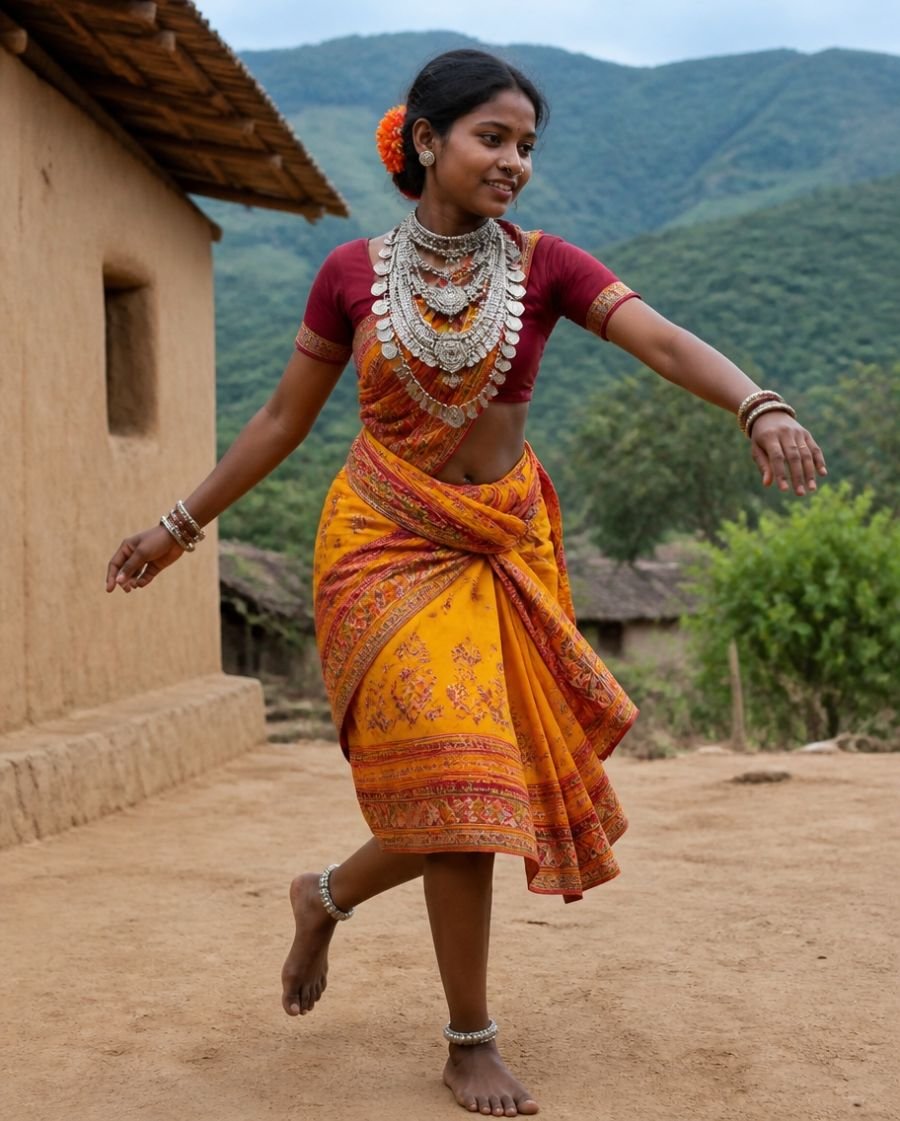
There is one memorable exception to the “no uniform” rule. For the Guinness World Record attempt in 2026, organisers put the entire 13,102-strong cast in coordinated pink traditional saris with green borders and green blouses — one palette repeated across 433 circles of dancers, which is what made the aerial photographs of the event so striking. It was a staged, unified version of what village Dhimsa does naturally: many individuals dressed for the same celebration, moving as one.
Dhimsa Dance Music and Instruments
Dhimsa is danced to live music. The chain follows the drummers, and the documented ensemble is built around drums with a horn carrying the melody above them. The music is usually played by men while the women dance. Not every performance uses the same set of instruments — the group depends on which players and instruments are available in the village — but the instruments below appear consistently in credible descriptions of the dance.
| Instrument | Type | Role in the dance |
|---|---|---|
| Tudumu (thudum) | Drum | The large drum whose deep beat is the heartbeat of the dance; often played in pairs. |
| Dappu | Frame drum | A flat frame drum played with a short stick — sharp and fast, carrying the intricate top rhythm. |
| Mori | Wind instrument | A horn whose piercing melodic line rides above the drums; the most recognisable sound of a Dhimsa performance after the drums themselves. |
| Kiridi and gilka | Small percussion | Smaller percussion that thickens the texture of the rhythm. |
| Jodukommulu | Horn clappers | Paired horn clappers, now rarer, recorded in older accounts of the tradition. |
The dappu drum is a tradition in its own right in Andhra Pradesh — it also drives the dappu drum dance of the state — which is why the same instrument can carry both a village festival rhythm and a stage performance.
Many varieties are sung as well as drummed, in the communities' own languages and in the local Odia- and Telugu-influenced dialects of the border hills. The commonest structure is call-and-response: a leader sings a line, the chain answers, and the exchange keeps time as reliably as any drum. In the Gunderi (Usku) variety the call-and-response happens between the men and the women themselves — the dance becomes a conversation. The lyrics stay close to home: planting and harvest, forest and weather, courtship and marriage, and the deity of the village.
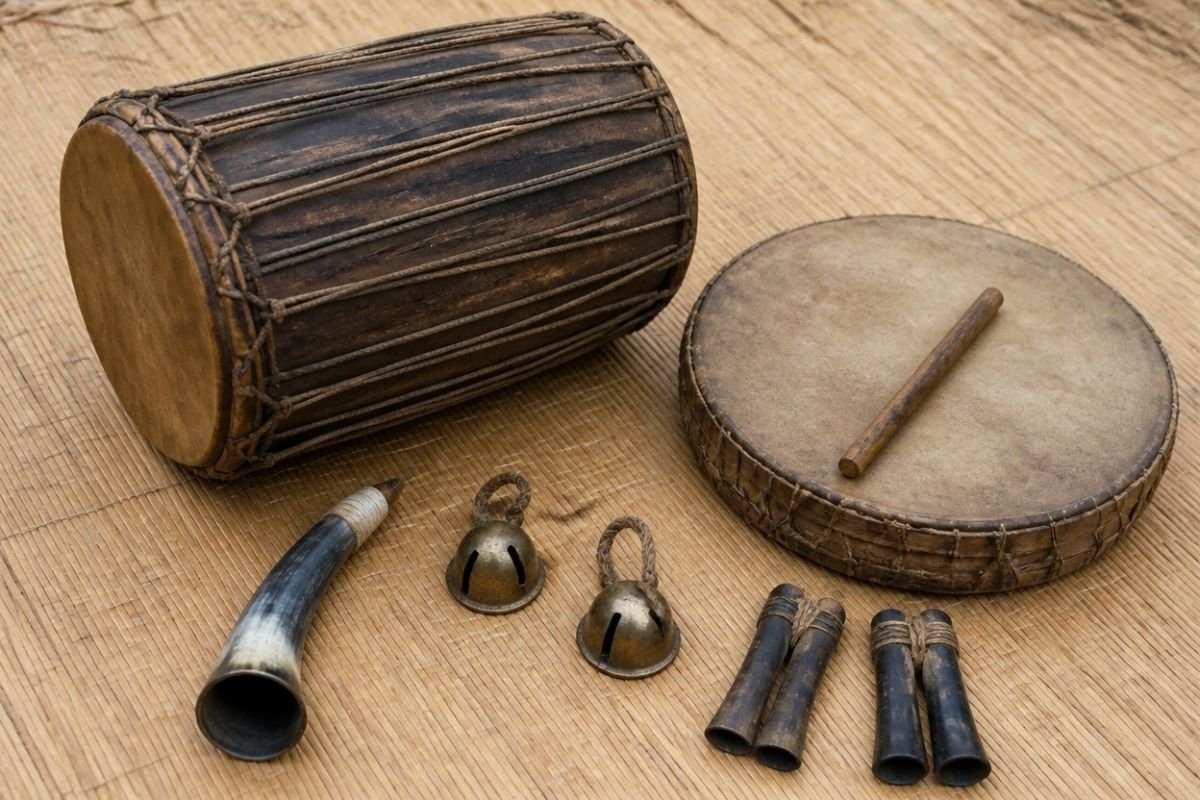
In its village form there is no amplification. At staged events the drummers are simply multiplied — the Bhogapuram record performance used massed dappu, mori and tudumu players to carry the rhythm to thirteen thousand dancers at once. If you are planning a Dhimsa performance at an indoor venue, live drumming is the sound the dance is built for, and it is worth confirming with the performers how the ensemble will be miked rather than substituting recorded music.
Types and Variations of Dhimsa Dance
Dhimsa is not one dance but a family. It is traditionally counted as twelve varieties, each with its own occasion, steps and meaning — but the exact list varies from village to village and from source to source. Folk traditions are not filing systems, and where sources disagree it is more accurate to describe the uncertainty than to publish a definitive inventory. The varieties below are the best documented.
| Variety | What distinguishes it |
|---|---|
| Boda Dhimsa | The ritual opening dance, performed in honour of the village deity — the form with the most ceremony attached. |
| Gunderi (Usku) Dhimsa | The playful, flirtatious variety: men dance holding peacock feathers and call the women to join — a courtship in dance form. |
| Goddi Beta Dhimsa | Known for synchronised backward-and-forward bending, with the whole chain swinging as one. |
| Bhag (Bagh) Dhimsa | A story-dance in which the chain enacts escaping a tiger's attack — a very real theme in these forested hills. |
| Natikari Dhimsa | Unusual for being a solo form, associated particularly with the Valmiki community and danced at Diwali. |
| Pedda Dhimsa | “The big Dhimsa” — the grand, principal form performed for major celebrations. |
Other names you will meet
Lists compiled by folklorists and cultural bodies also record varieties such as Kunda Dhimsa, Pathartola Dhimsa, Bayya Dhimsa, Mouli (Choti) Dhimsa and Sambar Nisani Dhimsa, among others. Descriptions of these are thinner and sometimes contradictory — a reminder that the tradition lives in performance rather than on paper, and that “twelve” is as much a way of saying many and complete as it is an exact count.
What unites all the varieties is the linked chain, the drum-led rhythm, and movements drawn from the daily and ritual life of the hills. If a specific variety matters for your event — for example a ritual Boda Dhimsa opening rather than a celebratory Pedda Dhimsa — it is best to say so in your enquiry, because the choice of variety changes the steps, the songs and the length of the performance.
Cultural Significance of Dhimsa Dance
Dhimsa carries more than entertainment. In the hills it functions as a social institution — a way for communities to meet, celebrate together and mark the turning points of the agricultural year. Because the dance is shared across several communities rather than owned by one, it works as a common language between villages that otherwise have separate identities, and it keeps oral history alive in movement and song.
It also marks the calendar. Festivals, harvests, weddings and hunting festivals such as Itika Pongal are all occasions for Dhimsa, and the dance is one of the ways a community announces that a season has changed or a celebration has begun.
In recent decades the dance has acquired a second life as a symbol. Teaching Dhimsa in tribal welfare residential schools turned it into a shared heritage for a generation of schoolchildren, staging it for visitors made it part of the Araku Valley's tourism identity, and the 2026 Guinness World Record at Bhogapuram turned it into a statement of pride for Andhra Pradesh's tribal communities at national scale.
For anyone presenting Dhimsa outside its home region, that context is the point. It is a living community tradition first and a stage performance second — which is why a respectful presentation explains the dance, credits the communities it comes from and uses live musicians rather than treating it as background entertainment.
Traditional Dhimsa Dance Performance
A traditional Dhimsa performance is a group event built around coordination rather than staging. What an authentic presentation involves, and what varies, can be summarised as follows.
-
Group coordination
The core of the performance is a linked chain or circle of dancers moving in unison. Precision across the group is what makes the dance read correctly.
-
Live rhythm
Drummers and, in many varieties, singers drive the dance. The tempo follows the musicians, and call-and-response singing is part of the form.
-
Festive dress
Traditional saris, silver tribal ornaments and anklets, flowers in the hair, and bare feet on the ground or stage.
-
Cultural presentation
The dance is presented as a community tradition, with its occasion and meaning explained rather than presented as anonymous folk entertainment.
-
Regional variation
The variety performed, the songs used and details of dress differ by community and village. There is no single standard edition of Dhimsa.
-
Space and ground
A chain or circle needs room to form and to travel. In the village form the dance is on earth, which is why many groups perform barefoot.
Because the tradition varies this much, the most useful thing an event organiser can do is be specific about what is needed — group size, duration, whether live drummers and singers are required, and whether the venue allows barefoot performance on the stage. Those details shape both the performance and the cost.
Book Dhimsa Dance Performers for Cultural Events
Dhimsa works well wherever an audience should experience a genuine Indian folk tradition rather than a generic dance number. Because it is a group circle dance with live drumming, it reads powerfully on both a festival ground and a stage — and it carries a story that is easy to introduce to an audience that has never seen it.
Occasions where a Dhimsa performance fits
- Cultural festivals and folk-art festivals
- College and university cultural programmes
- Corporate cultural events and India-themed evenings
- Tourism and heritage celebrations
- Public cultural programmes and state or district functions
- Weddings and community celebrations with a folk-culture theme
What to confirm before booking a Dhimsa group
A Dhimsa performance is assembled around your event, so a few details decide what is possible. Event organisers should confirm all of the following before finalising:
- Performer availability on your date, especially in the March–April festival season and around the valley's major cultural festivals.
- Group size — the number of dancers and musicians you need, since the dance depends on a group rather than a soloist.
- Performance duration and number of sets, because Dhimsa is traditionally danced in repeated cycles rather than a single fixed-length piece.
- Location and travel — the distance from the performers' base in the Araku region affects both logistics and cost.
- Stage space — enough clear floor area for a chain or circle to form and move, plus space for the drummers.
- Technical support — how live drums and the mori horn will be miked at your venue, and whether the stage allows barefoot performance.
- Pricing — quoted per event. Rates depend on group size, duration, travel and the format you need, so there is no single published price.
We do not publish fixed package prices or artist names for Dhimsa, because both depend on the event. Every enquiry is answered with the availability and options that fit your specific date and venue.
Enquire About Dhimsa Dance Performers
Share your event details and we will come back with availability and a customised quotation for a Dhimsa dance group. Fields marked * are required.
Your details are used only to respond to this enquiry. Prefer to talk it through? Call +91 93199 77060 or message the booking team on WhatsApp, or use the main enquiry page.
How to Book a Dhimsa Dance Group
The process is deliberately simple, and it starts with information rather than a price list, because a Dhimsa booking is put together around your event.
- Share the event date and location. The date decides availability, and the venue city or address decides travel and logistics.
- Explain the event type and expected audience. A college cultural programme, a corporate evening and a public festival each call for a different presentation.
- Confirm the performance format and group size. Tell us how long the performance should run, how many dancers and musicians you need, and whether you want live drumming and singing.
- Request availability and a customised quotation. With the details above, the team can confirm whether a group is free and quote for your event rather than a generic package.
- Finalise arrangements after confirmation. Once availability and the format are agreed, the booking, timing and coordination details are confirmed with you.
Availability and pricing always depend on the specific event requirements — the date, the location, the size of the group and the length of the performance. Nothing is confirmed until those details are agreed on both sides.
Start a Dhimsa booking enquiry
Planning a larger cultural programme? Dhimsa often sits alongside other folk traditions in a single event, and our cultural event management team can coordinate the full running order rather than a single act.
Frequently Asked Questions About Dhimsa Dance
Short, factual answers to the questions people ask most often about Dhimsa.
What is the Dhimsa dance of Andhra Pradesh?
Dhimsa is a tribal folk dance of the Araku Valley and the hill tracts of the Eastern Ghats in Alluri Sitharama Raju district, Andhra Pradesh. Dancers link arms or rest their hands on each other's shoulders and move in a chain or circle, stepping, swaying and stamping in unison to drums and a horn. The name is usually explained as echoing the sound of dancing footsteps.
Which tribe performs the Dhimsa dance?
Dhimsa is not the property of a single community. It is most strongly associated with the Porja (Poraja) communities, and it is also danced by the Bagata, Valmiki, Khond, Kotia and Gadaba communities of the Araku and Paderu hills, along with Kondadora, Mukadora, Jatapu and Konda Savara communities across the Andhra Pradesh–Odisha border country. Sources differ on how many communities dance it.
What is the history and origin of the Dhimsa dance?
Dhimsa is usually traced to the Koraput hills of present-day southern Odisha and is understood to have travelled with hill communities into the Araku Valley and the agency tracts above Visakhapatnam. Its movements borrow from daily hill life — gathering leaves, sowing, guarding the village — and it was traditionally danced as relief during working hours. During the twentieth century it moved from village grounds to district fairs, state cultural festivals and Republic Day parades, and the tribal welfare administration began teaching it in its residential schools.
What costumes are worn during the Dhimsa dance?
Dancers wear their best festive clothes rather than a theatre costume. Women wear brightly coloured saris tied so that the legs stay free for the stepping patterns, with silver or white-metal tribal ornaments — necklaces, heavy bangles, ear and nose rings — and anklets that add their own percussion. Flowers, and sometimes leaves or a peacock feather, are worn in the hair, and the dance is performed barefoot on earth.
Which instruments are used in the Dhimsa dance?
The documented ensemble centres on drums and a horn: the tudumu (or thudum), a large drum; the dappu, a flat frame drum played with a short stick; and the mori, a wind instrument whose piercing melodic line rides above the drums. Smaller percussion such as kiridi and gilka thicken the texture, and paired horn clappers called jodukommulu are recorded in older accounts. The music is usually played by men while the women dance, and many varieties are also sung in call-and-response form.
Where is the Dhimsa dance traditionally performed?
Dhimsa belongs to the Araku Valley and the agency hill tracts of Alluri Sitharama Raju district in Andhra Pradesh, with roots across the border in the Koraput region of Odisha. It is performed at festivals — particularly the March to April festival season — at weddings, at harvest and hunting festivals such as Itika Pongal, and at village and community gatherings. It is also staged regularly for visitors in the Araku Valley.
Can Dhimsa dance performers be booked for cultural events?
Yes. Dhimsa is a performed folk tradition, and it can be presented at cultural festivals, college cultural programmes, corporate cultural events, tourism and heritage celebrations and public cultural programmes. Because it is a live community dance with drummers and singers, availability depends on the date, the location and the size of group you need, so enquiries are handled case by case.
What details are required to book a Dhimsa dance group?
Share the event date and venue, the type of event and the expected audience, the performance format you want (duration, number of dancers, whether live drummers are required) and any stage or travel requirements. With those details you can be given availability and a customised quotation. Pricing depends on group size, duration and travel, so it is quoted per event rather than published as a fixed rate.
Sources and Further Reading
The cultural information on this page is based on the sources below, with details qualified where accounts differ.
- Alluri Sitharama Raju District administration, Government of Andhra Pradesh — cultural tourism pages describing Dhimsa as the most famous cultural expression of the Araku Valley hill tribes, the typical group of 15 to 20 women, and the mori, thudum and dappu instruments.
- Guinness World Records — official record entry for the largest Dhimsa dance: 13,102 participants, Department of Tribal Welfare, Government of Andhra Pradesh, Bhogapuram, 31 July 2026.
- The Hindu — reporting on the Bhogapuram record performance, including the 433 circular formations of around 50 dancers each.
- Encyclopaedic and reference accounts of Dhimsa — for the Koraput origin, the “sound of the footsteps” meaning, the twelve-variation count, and the documented instrument list including kiridi and jodukommulu.
- Folklorist and cultural-body listings of Dhimsa varieties — for the best-documented varieties and the communities associated with the dance.
Where sources disagree — for example on the exact number of Dhimsa varieties or the number of communities that dance it — this page describes the disagreement rather than choosing one version.
Other folk traditions of Andhra Pradesh
Dhimsa is one of many living folk traditions in the state. If you are building a broader cultural programme, these pages cover other forms: the folk dances of Andhra Pradesh, the dappu drum dance, Burrakatha and Butta Bommalu — or browse all folk dances of India.
Cultural content on this page was last reviewed in October 2026. Dhimsa is a living tradition, and details such as the number of varieties and the participating communities are described as sources present them.